Education
Marguerite Thomas Williams was born in Washington, D.C. on December 24, 1895. She received her Bachelor of Arts degreee from Howard University in 1923 and a Master of Arts degree from Columbia University in 1930. Marguerite Thomas Williams earned a Ph.D. in Geology from Catholic University of America in 1942, as the first African American (male or female) to earn a doctorate in geology in the United States.
Dr. Williams was employed as a teacher in Miner Teachers College (now part of the University of the District of Columbia) from 1923-29. Dr. Williams served as Chairman of the Division of Geography (1923-33) and served from Assistant Professor to full Professor in the Department of Social Sciences, Miner Teachers College, from 1943 to 1955. Marguerite Williams also served as an Instructor for the Evening School at Howard University, 1944.
Slavery
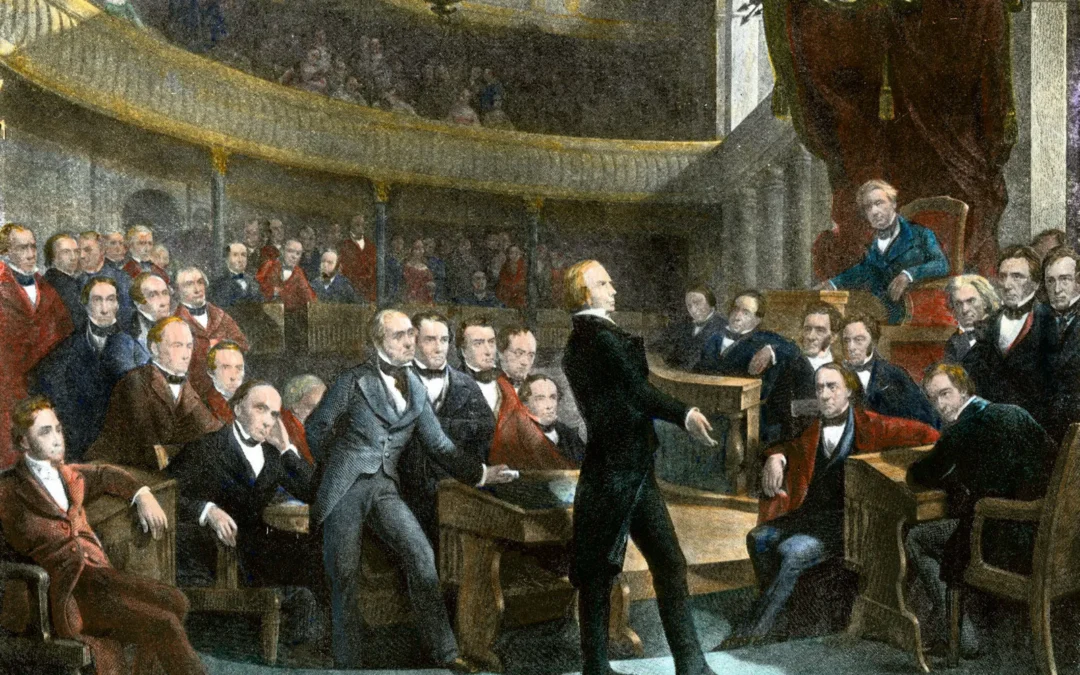
Henry Clay, U.S. senator from Kentucky, was determined to find a solution. In 1820 he had resolved a fiery debate over the spread of slavery with his Missouri Compromise. Now, thirty years later, the matter surfaced again within the walls of the Capitol. But this time the stakes were higher — nothing less than keeping the Union together.
There were several points at issue:
? The United States had recently acquired a vast territory — the result of its war with Mexico. Should the territory allow slavery, or should it be declared free? Or maybe the inhabitants should be allowed to choose for themselves?
? California — a territory that had grown tremendously with the gold rush of 1849, had recently petitioned Congress to enter the Union as a free state. Should this be allowed? Ever since the Missouri Compromise, the balance between slave states and free states had been maintained; any proposal that threatened this balance would almost certainly not win approval.
? There was a dispute over land: Texas claimed that its territory extended all the way to Santa Fe.
? Finally, there was Washington, D.C. Not only did the nation’s capital allow slavery, it was home to the largest slave market in North America.
On January 29, 1850, the 70-year-old Clay presented a compromise. For eight months members of Congress, led by Clay, Daniel Webster, Senator from Massachusetts, and John C. Calhoun, senator from South Carolina, debated the compromise. With the help of Stephen Douglas, a young Democrat from Illinois, a series of bills that would make up the compromise were ushered through Congress.
According to the compromise, Texas would relinquish the land in dispute but, in compensation, be given 10 million dollars — money it would use to pay off its debt to Mexico. Also, the territories of New Mexico, Nevada, Arizona, and Utah would be organized without mention of slavery. (The decision would be made by the territories’ inhabitants later, when they applied for statehood.) Regarding Washington, the slave trade would be abolished in the District of Columbia, although slavery would still be permitted. Finally, California would be admitted as a free state. To pacify slave-state politicians, who would have objected to the imbalance created by adding another free state, the Fugitive Slave Act was passed.
Of all the bills that made up the Compromise of 1850, the Fugitive Slave Act was the most controversial. It required citizens to assist in the recovery of fugitive slaves. It denied a fugitive’s right to a jury trial. (Cases would instead be handled by special commisioners — commisioners who would be paid $5 if an alleged fugitive were released and $10 if he or she were sent away with the claimant.) The act called for changes in filing for a claim, making the process easier for slaveowners. Also, according to the act, there would be more federal officials responsible for enforcing the law.
For slaves attempting to build lives in the North, the new law was disaster. Many left their homes and fled to Canada. During the next ten years, an estimated 20,000 blacks moved to the neighboring country. For Harriet Jacobs, a fugitive living in New York, passage of the law was “the beginning of a reign of terror to the colored population.” She stayed put, even after learning that slave catchers were hired to track her down. Anthony Burns, a fugitive living in Boston, was one of many who were captured and returned to slavery. Free blacks, too, were captured and sent to the South. With no legal right to plead their cases, they were completely defenseless.
Passage of the Fugitive Slave Act made abolitionists all the more resolved to put an end to slavery. The Underground Railroad became more active, reaching its peak between 1850 and 1860. The act also brought the subject of slavery before the nation. Many who had previously been ambivalent about slavery now took a definitive stance against the institution.
The Compromise of 1850 accomplished what it set out to do — it kept the nation united — but the solution was only temporary. Over the following decade the country’s citizens became further divided over the issue of slavery. The rift would continue to grow until the nation itself divided.
Events
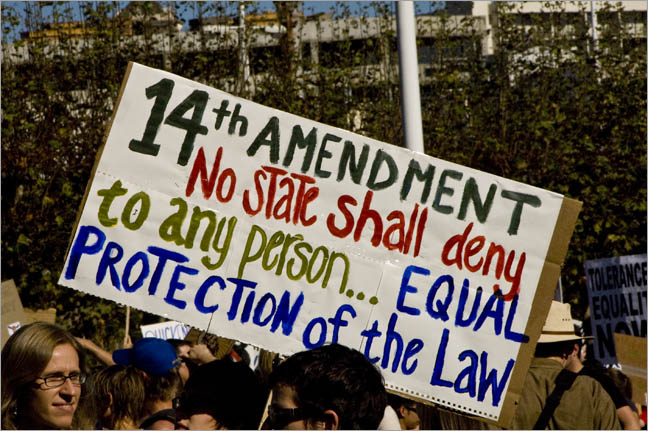
Section. 1. All persons born or naturalized in the United States and subject to the jurisdiction thereof, are citizens of the United States and of the State wherein they reside. No State shall make or enforce any law which shall abridge the privileges or immunities of citizens of the United States; nor shall any State deprive any person of life, liberty, or property, without due process of law; nor deny to any person within its jurisdiction the equal protection of the laws.
Section. 2. Representatives shall be apportioned among the several States according to their respective numbers, counting the whole number of persons in each State, excluding Indians not taxed. But when the right to vote at any election for the choice of electors for President and Vice President of the United States, Representatives in Congress, the Executive and Judicial officers of a State, or the members of the Legislature thereof, is denied to any of the male inhabitants of such State, being twenty-one years of age, and citizens of the United States, or in any way abridged, except for participation in rebellion, or other crime, the basis of representation therein shall be reduced in the proportion which the number of such male citizens shall bear to the whole number of male citizens twenty-one years of age in such State.
Section. 3. No person shall be a Senator or Representative in Congress, or elector of President and Vice President, or hold any office, civil or military, under the United States, or under any State, who, having previously taken an oath, as a member of Congress, or as an officer of the United States, or as a member of any State legislature, or as an executive or judicial officer of any State, to support the Constitution of the United States, shall have engaged in insurrection or rebellion against the same, or given aid or comfort to the enemies thereof. But Congress may by a vote of two-thirds of each House, remove such disability.
Section. 4. The validity of the public debt of the United States, authorized by law, including debts incurred for payment of pensions and bounties for services in suppressing insurrection or rebellion, shall not be questioned. But neither the United States nor any State shall assume or pay any debt or obligation incurred in aid of insurrection or rebellion against the United States, or any claim for the loss or emancipation of any slave; but all such debts, obligations and claims shall be held illegal and void.
Section. 5. The Congress shall have power to enforce, by appropriate legislation, the provisions of this article.
Education
Mordecai Wyatt Johnson (January 4, 1890 – September 10, 1976) was an American educator and pastor. He served as the first African American president of Howard University from 1926 until 1960. Johnson has been considered one of the three leading African American preachers of the early 20th-century, along with Vernon Johns and Howard Thurman.
Johnson was born on January 12, 1890, in Paris, Tennessee, to parents who were former slaves. His father was Reverend Wyatt J. Johnson, a preacher and mill worker. His mother, Carolyn Freeman, was a domestic worker for one of the prominent families in town.
Read more of this article on Wikipedia.
