
The Arts
Stowe’s landmark novel, Uncle Tom’s Cabin, has often been cited as one of the causes of the Civil War. She became outraged by written accounts of the injustice and cruelty of the slave system and traveled to the South to investigate it herself. The material she gathered became the source for Uncle Tom’s Cabin; or Life Among the Lowly. The book, which was first published in 1831 in serial form in an abolitionist newspaper, became an immediate sensation, soon gaining worldwide popularity. Stowe was also an ardent supporter of women’s rights, and she collaborated with her sister, Catherine Beecher, on nineteen domestic-science books.
Slavery
Angelina Grimke, along with her sister Sarah, were the first women in the United States to publicly argue for the abolition of slavery. Cultured and well educated, Angelina had gone north from South Carolina with her sister with firsthand knowledge of the condition of the slaves. In 1836 Angelina wrote a lengthy address urging all women to actively work to free blacks. The sisters’ lectures elicited violent criticism because it was considered altogether improper for women to speak out on political issues. This made them acutely aware of their own oppression as women, which they soon began to address along with abolitionism. A severe split developed in the abolition movement, with some antislavery people arguing that it was the “Negro’s hour and women would have to wait.” The Grimkes refused to accept this idea, insisting on the importance of equality for both women and blacks. Angelina’s sister became a major theoretician of the women’s rights movement, challenging all the conventional beliefs about a woman’s place. As to men, she demanded: “All I ask of our brethren is that they will take their feet from off our necks.”
The Arts
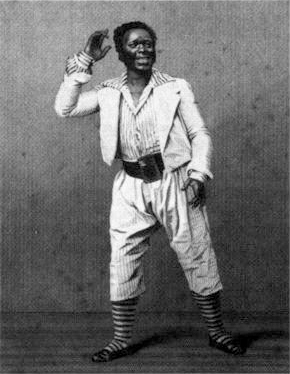
Ira Aldridge was born around 1805. His place of birth has been listed as Africa but more often Bel Air, Maryland. He was apprenticed as a carpenter under a German immigrant. Aldridge learned carpentry as well as German. Because of the lack of schools for African-Americans in Maryland, Aldridge moved to New York and attended the African Free School and Schenectady College. It was at Schenectady that Aldridge became interested in acting. He raised money and moved to Glasgow, Scotland.
He studied at the University of Glasgow, developing voice projection and dramatic skills. Aldridge was so gifted that by 1837 he was drawing crowds to see him portray Shakespearian roles. Aldridge was such a great actor that he performed for the president of the U.S., Queen Victoria and the Archduch of Chambory. He received many awards and was heavily decorated. Aldridge was even the first African-American to become a knight. He married twice and was divorced once. Aldridge died in Poland in 1867. At the Shakespearean Memorial Theatre in Stratford-On-Avon, England, a chair is dedicated to the memory of Ira Aldridge.

Music
Eubie Blake, ragtime composer and performer, was born on February 7,1883 in Baltimore, Md. When he was around four or five, Blake began playing his family’s pump organ. Noticing his interest in music, Blake’s parents signed him up for piano lessons with a neighborhood teacher. In 1898, at the age of 15, Blake became interested in ragtime, to his mother’s dismay. Against her wishes and without her knowing, he began his professional music career by playing ragtime piano in Baltimore brothels, honky tonks and bars. He later played in clubs and saloons. Blake’s work led him to meet the major musicians of the time. One of whom, Noble Sissle, would later become his partner.
The pair met in 1915. Sissle joined Blake’s band as a singer. Noble Sissle and Eubie Blake created an vaudeville act, the Dixie Duo. They wrote songs and performed. Sophie Tucker sang their first song, “It’s all your fault.” The song was an instant hit. Then Blake and Sissle teamed up with another duo to create Shuffle Along The Broadway all-star cast included Josephine Baker Florence Mills and Paul Robeson. Many of Blake’s most famous songs come from Shuffle Along including “I’m Just Wild about Harry” and “Love Will Find a Way”. The play was so popular that in 1921 it was being performed by three different touring companies. After the success of Shuffle Along ,
Blake and Sissle collaborated on Elsie and Chocolat Dandies. Blake also created some shows on his own including Swing It, Blackbirds and Eubie! Then, as the popularity of ragtime faded, Eubie Blake took a twenty-three year break from show business. In 1969, at the age of 56 he returned. Blake toured the world playing piano and giving lectures on ragtime music. He made an album called The Fifty-six Years of Blake and he formed his own company. Just over one hundred years after his life began, on February 12, 1983, Eubie Blake died in Brooklyn, New York.
The Arts
Freedom’s People
(1941-42)
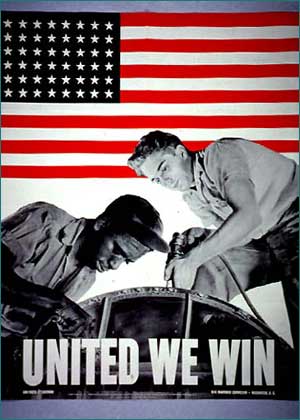
The first substantial program in mass media devoted exclusively to African-American life and history. Freedom’s People was a 9-part series on NBC exploring black history and achievements in areas like music, science, industry and sports. Created by Ambrose Caliver, a black official in the Office of Education, Freedom’s People earned critical acclaim. It features the contributions of leading black intellectuals, artists and activists.
