Black History, History
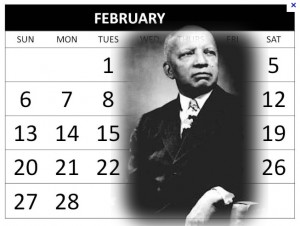
Carter G. Woodson Launched Negro History Week in 1926.
Black History Month, also known as African-American History Month, is an annual observance in the United States, Canada, and the United Kingdom for remembrance of important people and events in the history of the African diaspora. It is celebrated annually in the United States and Canada in February and the United Kingdom in October.Black History Month had its beginnings in 1926 in the United States, when historian Carter G. Woodson and the Association for the Study of Negro Life and History announced the second week of February to be “Negro History Week”. (more…)
Black History, The Arts

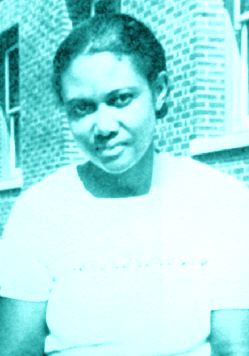
Zora Neale Hurston
Though during her life Zora Neale Hurston claimed her birth date as January 7, 1901 and her birth place as Eatonville, Florida, she was actually born on that date in the year 1891 in Notasulga, Alabama. Within the first year or two of her life her family moved to all-black Eatonville, however, and this community shaped her life and her writing to a significant degree.
ohn Hurston, the author’s father, was a carpenter and a preacher and was several times elected mayor of their town. Her mother, Lucy, died in 1904. The young Zora didn’t take very well to her new stepmother and left home to work for a traveling theatre company, then in 1917 attended Morgan Academy in Baltimore to finish high school. (more…)
Black History, Education, Law
 The NAACP Legal Defense and Educational Fund (LDF) is the country’s first and foremost civil and human rights law firm. Founded in 1940 under the leadership of Thurgood Marshall, who subsequently became the first African-American U.S. Supreme Court Justice, LDF was launched at a time when the nation’s aspirations for equality and due process of law were stifled by widespread state-sponsored racial inequality. From that era to the present, LDF’s mission has always been transformative: to achieve racial justice, equality, and an inclusive society.
As the legal arm of the civil rights movement, LDF has a tradition of expert legal advocacy in the Supreme Court and other courts across the nation. LDF’s victories established the foundations for the civil rights that all Americans enjoy today. In its first two decades, LDF undertook a coordinated legal assault against officially enforced public school segregation. (more…)
Black History, Science
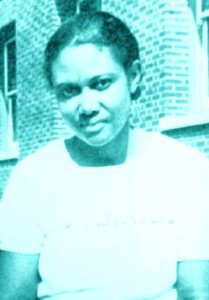
Roger Arliner Young
Roger Arliner Young was the first African-American woman to receive a doctorate in zoology, after years of juggling research and teaching with the burden of caring for her invalid mother. Her story is one of grit and perseverance.
Roger Arliner Young grew up in Burgettstown, Pennsylvania. In 1916, she entered Howard University. In 1921, she took her first science course, under Ernest Everett Just, a prominent black biologist and head of the zoology department at Howard. Although her grades were poor, Just saw some promise and started mentoring Young. She graduated with a bachelor’s degree in 1923.
Her relationship with Just improved her skills, and he continued working with her. According to his biographer, Just probably chose a woman protégé because he thought men more likely to pursue lucrative careers in medicine than to remain in academe. Just helped Young find funding to attend graduate school.
In 1924 she entered the University of Chicago part-time. Her grades improved dramatically. She was asked to join Sigma Xi, an unusual honor for a master’s student. She also began publishing her research. Her first article, “On the Excretory Apparatus in Paramecium,” appeared in Science in September 1924. She obtained her master’s degree in 1926. (more…)
Black History, Government
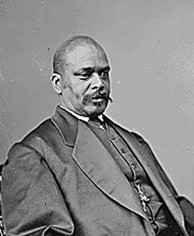
Oscar James Dunn, Lieutenant Governor of Louisiana 1868-1871
Oscar James Dunn (1826 – November 22, 1871) was one of three African Americans who served as a Republican Lieutenant Governor of Louisiana during the era of Reconstruction. In 1868, Dunn became the first elected black lieutenant governor of a U.S. state. He ran on the ticket headed by Henry Clay Warmoth, formerly of Illinois. After Dunn died in office, then-state Senator P. B. S. Pinchback, another black Republican, became lieutenant governor and thereafter governor for a 34-day interim period.
On December 22, 1866, Dunn testified before a select committee appointed to investigate the New Orleans Riot of July 30, 1866. He told the committee that he was “born in New Orleans in 1826 and was about forty-one years old”. His parents were James and Maria Dunn. His father, James Dunn of Petersburg, Virginia, had been emancipated in 1819 by James H. Caldwell in New Orleans. James Dunn became a free man of color and later emancipated his wife, Maria, and their two children, Oscar and Jane, in 1832. James Dunn worked as a carpenter for James H. Caldwell (founder of the St. Charles Theatre and New Orleans Gas Light Company); Maria Dunn ran a boarding house for actors and actresses that came to perform at the Caldwell theatres. (more…)