Events
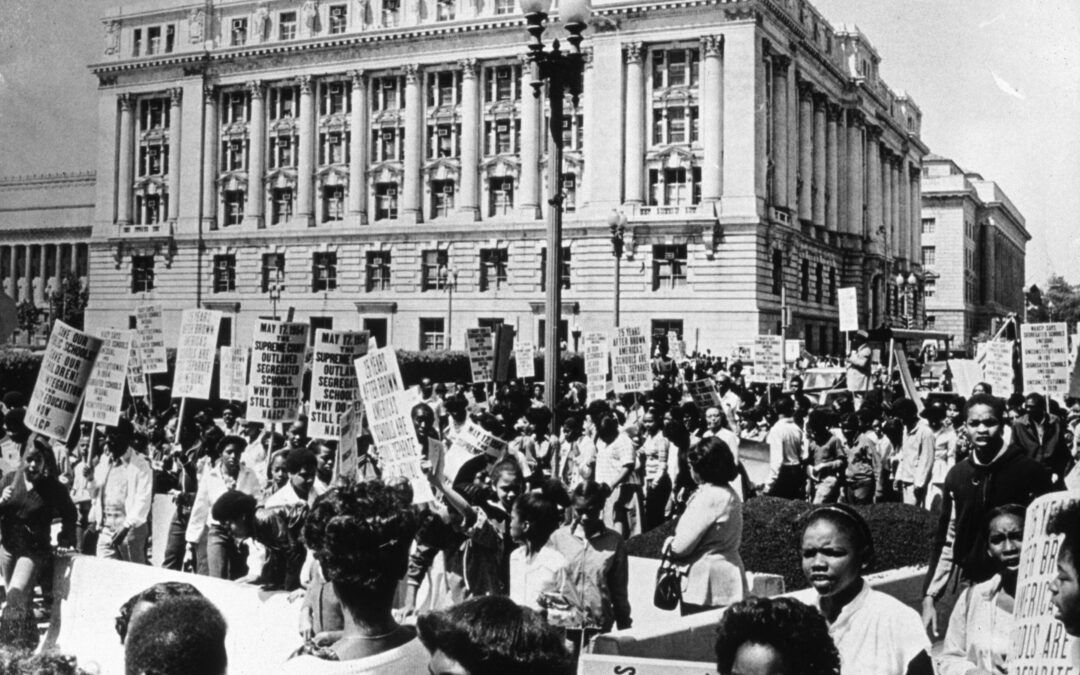
During the 1940s and 1950s, NAACP lawyer Thurgood Marshall directed a carefully constructed legal campaign against Southern segregation laws. These laws separated blacks and whites in such areas of public life as schools, restaurants, drinking fountains, bus stations, and public transportation. The NAACP focused on segregation in education, and won a number of court victories, culminating in the Supreme Court’s ruling in 1954 in Brown v. Board of Education of Topeka. This ruling declared that separate facilities were inherently unequal and therefore unconstitutional, thus reversing the 1896 Plessy v. Ferguson ruling.
However, President Dwight D. Eisenhower did not support a strong federal role in enforcing desegregation, an attitude that encouraged Southern resistance. State troopers were used in Texas to prevent integration; people who supported integration risked losing their jobs; and segregationists set off bombs in Tennessee and Alabama. In a “Southern Manifesto,” 101 congressmen vowed to resist integration.
Meanwhile, after three years of negotiation, the black community and the school board in Little Rock, Arkansas, devised a plan to enroll nine black students at Central High School. When the plan was implemented in the fall of 1957, Governor Orval Faubus used the National Guard to block the black students from entering the school. The public outcry forced Eisenhower to act. He put the National Guard under federal direction and sent federal troops to enforce the Brown decision and protect the students from white mobs. Nevertheless, the following year, Faubus closed all of Little Rock’s high schools rather than integrate them. Ten years after the Brown decision, less than two percent of Southern black children attended integrated schools.
Whites in many areas of the South organized private white schools rather than accept integration. In 1959 officials in Prince Edward County, Virginia, moved white students and state education funds to hastily organized white private schools. For four years, until privately funded black schools could be organized, black students in the county had no schools. Finally in 1963 the county complied with court rulings and reopened the public schools. During the early 1960s, it was necessary to maintain federal troops and marshals on the University of Mississippi campus to ensure the right of a black student to attend classes.

Slavery
Led by his father George Garnett, Henry Highland Garnett escaped from Maryland slavery in 1825 to New York. Henry attended the New York African Free school. Among his classmates were Alexander Crummell, Ira Aldridge and Thomas Ringgold Ward. His goal was to continue his education in New Hampshire but a group of whites decided to eliminate the school for educating blacks and dragged the building into the swamp. Under his leadership, Garnett and the other black students (including Alexander Crummell) prepared for an attempt on their lives which would come one night before they could leave town. They successfully defended themselves against the nighttime attack.
Garnett’s ideas about black liberation came to a national audience. He was convinced that in spite of the admirable efforts of the white abolitionist, that the battle for black liberation belonged in the hands of blacks. Garnett would say that, “They are our allies – Ours is the battle.” He took revolutionary stands about slavery. Inspired by David Walker, he wrote to slaves: “you had better all die – die immediately than live lives as slaves and entail wretchedness upon your posterity. . . Where is the blood of your fathers? Has it run out of your veins? . . . Awake, awake, millions of voices are calling you. Your dead fathers speak to you from their graves.”
Garnett traveled to England to try to encourage a worldwide boycott of cotton. He knew that if the market for cotton collapses, slavery would not survive. Garnett would live his life with many ideas that opposed those of Frederick Douglass. Eventually however, his ideas about liberation, politics and economics would be embraced by many black leaders of his day.
Military
In January 1944, the naval officer corps was all white. There were some one hundred thousand African American enlisted men in the Navy, however, none were officers. In response to growing pressure from American civil rights organizations, the leaders of the Navy reluctantly set about commissioning a few as officers.
Sixteen black enlisted men were summoned to Camp Robert Smalls, Great Lakes Naval Training Station in Illinois:
Jesse W. Arbor
Samuel Barnes
Philip Barnes
Dalton Baugh
George C. Cooper
Reginald Goodwin
James E. Hair
Graham E. Martin
Dennis Nelson
John W. Reagan
Frank E. Sublett Jr.
William S. White
Charles Lear
Lewis Williams
J. B. Pinkney
A. Alves
All had demonstrated top-notch leadership abilities as enlisted men. The pace was demanding and forced the sixteen men to band together so that all could succeed.
During their officer candidate training, they compiled a class average of 3.89, a record that has yet to be broken.
Although all passed the course, in March 1944, 13 of the group made history when they became the U.S. Navy’s first African-American officers on active duty. 12 were commissioned as ensigns; the thirteenth was made a warrant officer.
They became known as the “Golden Thirteen.”
They were often denied the privileges and respect routinely accorded white naval officers and were given menial assignments.
Only one of the Golden Thirteen made a career of the Navy, and he opened still more doors to black officers. The other members of the group made their marks in civilian life after World War II.
Pioneers
1834-1886
One of the two black men who carried the mail on the famous Pony Express was George Monroe, son of an early California gold miner. His record as a reputable stagecoach driver led Monroe to the honor of driving Presidents Ulysses S. Grant and Rutherford B. Hayes along the dangerous S-curves of the Wanona Trail into Yosemite Valley. According to one description of his driving prowess, “he would throw those six animals from one side to the other to avoid a stone as if they were a single horse.
Crack went his whip every once in a while and down would go the team in a canter, around sharp curves and over plank culverts and up again on a clean run.” After Monroe’s death, Monroe Meadows (now Badger Pass) in Yosemite National Park was named in his honor. Today, television commercials for Wells Fargo Bank depict George Monroe driving a stagecoach.
Space
Frederick D. Gregory is the Associate Administrator for the Office of Space Flight. He began serving in this position, in an acting capacity, in December 2001. He was selected permanently in February 2002. He is responsible for overseeing the management of the International Space Station; Space Shuttle operations; Space Access using Expendable Launch Vehicles for commercial launch services; Space Communications; and Advanced Programs.
From June 1992 to December 2001, Mr. Gregory held the position of Associate Administrator, Office of Safety and Mission Assurance, at NASA Headquarters. As Associate Administrator, he was responsible for assuring the safety, reliability, quality, and mission assurance of all NASA programs.
Mr. Gregory has extensive experience as an astronaut, test pilot, and manager of flight safety programs and launch support operations. As a NASA astronaut, he logged 455 hours in space: as pilot for the Orbiter Orbiter Challenger (STS-51B) in 1985, as spacecraft commander aboard Discovery (STS-33) in 1989, and as spacecraft commander aboard Atlantis (STS-44) in 1991. Mr. Gregory served in several key positions as an astronaut, including Astronaut Office Representative for the first Space Shuttle flights (STS-1 and STS-2); lead Capsule Communicator (CAPCOM); Chief, Operational Safety at NASA Headquarters; and Chief, Astronaut Training. He also served on the Orbiter Configuration Control Board and Space Shuttle Program Control Board.
Mr. Gregory retired as a Colonel in the United States Air Force in December 1993 after logging 7,000 hours in more than 50 types of aircraft, including 550 combat missions in Vietnam. His 30-year Air Force career included serving as a helicopter pilot and as a fighter pilot. He graduated from the United States Naval Test Pilot School and served as an engineering test pilot for the Air Force and for NASA. He was selected as a pilot Astronaut in January 1978.
Mr. Gregory holds a Bachelor of Science degree from the United States Air Force Academy and a Master’s degree in Information Systems from George Washington University. He was awarded an honorary Doctor of Science degree from the University of the District of Columbia. He is a member or past member of numerous societies, including the Society of Experimental Test Pilots, American Helicopter Society, Air Force Academy Association of Graduates, the National Technical Association, the Tuskegee Airmen, and the Order of the Daedalians. He is on the Board of Directors for the Young Astronaut Council, Kaiser-Permanente, and Fisk University. He is on the Board of Trustees at the Maryland Science Center, and he is a member of the Executive Committee of the Association of Space Explorers. His honors include the Defense Superior Service Medal, the Legion of Merit, 2 Distinguished Flying Crosses, the NASA Distinguished Service Medal, a NASA Outstanding Leadership Award, National Intelligence Medal of Achievement, National Society of Black Engineers Distinguished National Scientist Award, the George Washington University Distinguished Alumni Award, and the Air Force Association Ira Eaker Award in addition to numerous civic and community honors.
