
Black History, Inventions
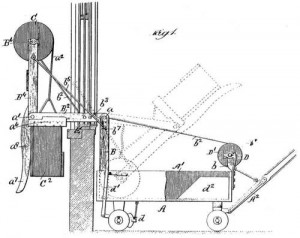 Chicago inventor Daniel McCree invented a portable fire escape that was designed for the interior of buildings.
McCree’s fire escape could roll and had a carriage that could be raised and lowered.
It was intended to be part of a building’s own fire prevention equipment and stored on location.
D. McCree improved on the fire-escape used in bigger buildings and created a portable wooden fire escape that could be attached to a home
McCree patented his portable fire escape on November 11, 1890 and it is the basis for models used today.
(U. S. Patent # 440,322 )
- Portable Fire Escape by Daniel McCree
Black History, Inventions
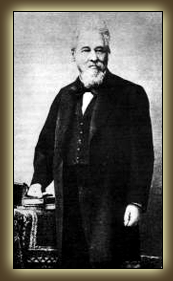
Norbert Rillieux
Norbert Rillieux was born on March 17, 1806 in New Orleans, Louisiana. Norbert was born a free man, although his mother was a slave. His father was a wealthy White engineer involved in the cotton industry. As a child Norbert was educated in the Catholic school system in New Orleans but was sent to Paris, France for advanced schooling.
He studied at the L’Ecole Centrale, the top engineering school in the country and at age 24 became an instructor of applied mechanics at the school, the youngest person to achieve this position. He published a series of papers related to “the Functions and Economic Implications of the Steam Engine.” Eventually, in 1834, Rillieux returned home to his father’s plantation which was now also being used to process and refine sugar.
(more…)
Black History, Inventions
Lewis Temple
Lewis Temple was the inventor of a whaling harpoon, known as “Temple’s Toggle” and “Temple’s Iron” that became the standard harpoon of the whaling industry in the middle of the 19th century. Lewis Temple was a skilled blacksmith, not a whaler. He had never even been to sea. Temple was born a slave in Richmond, Virginia, in 1800, and arrived in New Bedford, Massachusetts in 1829.
By 1836, Temple was one of the 315,000 free black people in the United States and a successful businessman who operated a whale craft shop on the New Bedford waterfront. Temple, a well-known citizen of New Bedford, was working as a blacksmith to support his wife, Mary Clark, whom he married in 1829, and their three children. In 1845, Temple was able to open a larger store. (more…)
Black History, Inventions
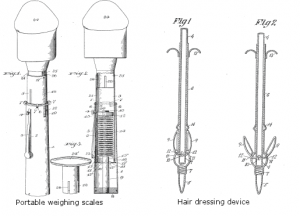
John W. Hunter, on Nov. 3, 1896, received patent number 570,553 for a portable weighing scales
John W. Hunter, on Jan. 19, 1909, received patent number 909,902 for a hair dressing device
J.H. Hunter, an African-American inventor, patented the weighing scale on November 3, 1896.It was patent number 570, 533. The weighing scale is used to determine the weight or mass of an object or individual.
On Jan. 19, 1909, he also received patent number 909,902 for a hair dressing device
Black History, Inventions
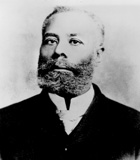
Elijah McCoy
Elijah McCoy (1843-1929) was a Black inventor who was awarded over 57 patents. The son of run-away slaves from Kentucky, he was born in Canada and lived there as a youth.
As a boy, the young Elijah was fascinated with machines and tools, learning by watching and constantly asking questions. He came to the United States after the Civil War and settled near Ypsilanti, Michigan, where he worked in a machine shop, further increasing his mechanical knowledge and skills. (more…)
Black History, Inventions, Science
 During his tenure at the Cities Service Oil Co. in the late ’60s, Ernest J. Jamieson patented four inventions on the improvement of current gasoline compositions. One invention improved hydrocarbon fuel compositions for use in internal combustion engines by adding a detergent that prevents icing and corrosion.
Another invention improved a hydrocarbon fuel composition by adding a X hydrocarbylacid phosphate salt that reduced icing in the carburetor and improved water tolerance, thus reducing rust and hydrocarbon content in the exhaust.

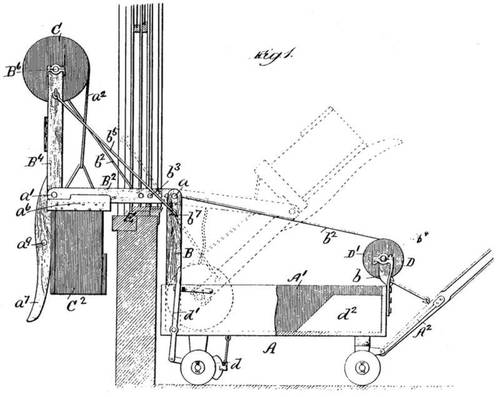 Chicago inventor Daniel McCree invented a portable fire escape that was designed for the interior of buildings.