Science
Earning his Ph.D. in 1918, he became the second African American to hold a doctorate in Physics, and in 1919 co- authored a signal work that opened an entirely new field of research – the study of molecular structure through the use of infra-red spectroscopy
Government
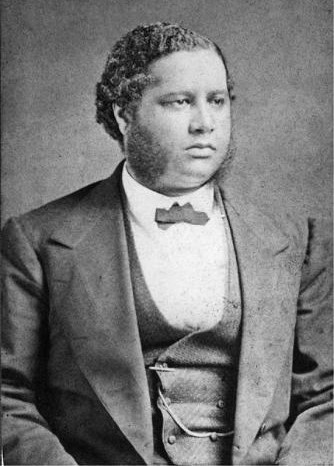
Francis L. Cardoza was elected State Treasurer of South Carolina in 1858.
Francis Lewis Cardozo was a minister, educator, and politician who was born free in Charleston, South Carolina, on February 1, 1836. Cardozo was of mixed ancestry, as his father, Isaac Nunez Cardozo, was a Sephardic Jew, and his mother, Lydia Williams Weston, was a free woman of color. South Carolina laws did not allow for interracial marriages, so the couple’s union was considered a common-law marriage. The couple had five children, three boys and two girls. Cardozo and his brothers were sent to a private school for children of color.
At the end of his schooling, Cardozo worked as a carpenter and shipbuilder. In 1858, he used his savings to pay his way on a ship headed to Scotland and enrolled at the University of Glasgow, where he began to study Greek and Latin. He studied at Edinburgh Theological and London seminaries and was an ordained Presbyterian minister when he returned to the United States in 1864. Cardozo became the pastor of the Temple Street Congregational Church in New Haven, Connecticut, and married Catherine Rowena Howell on December 20, 1864. The couple had six children.
Cardozo returned to Charleston in 1865 as an agent for the American Missionary Association (AMA), founded in 1846 by an abolitionist group from Albany, New York. He worked as the superintendent of an AMA-established school and was responsible for its transformation into The Avery Normal Institute. The institute focused on training Black teachers. Cardozo, a member of the Republican Party, became involved in Reconstruction politics. By 1868, he was selected as a delegate to the South Carolina State Constitutional Convention, where he chaired the education committee. He called for the dissolution of the plantation system and racially integrated schools. Cardozo’s speech led to his election as the first Black Secretary of State in South Carolina’s history later in 1868.
Read more of this article on BlackPast.org.
Medicine
1892-1971. Dr. Theodore K. Lawless was a skin specialist (dermatologist) who became a millionaire form his studies, practice adn development of medicines. He also contributed to the better understanding of syphilis, a venereal disease; and leprosy, a disease which wastes away the muscles of the body. Setting up his ofices in the heart of Chicago’s Black community, he established one of the largest and best known skin clinics in the city. For many years, men and women and children, both balack and white, crowded his waiting room from morning until night. But he still found time to teach at Northwestern University, work with the staff of Chicago’s Provident Hospital, and share his knowledge with other doctors. In 1954, he was awarded th NAACP’s Spingarn Medal.
Inventions
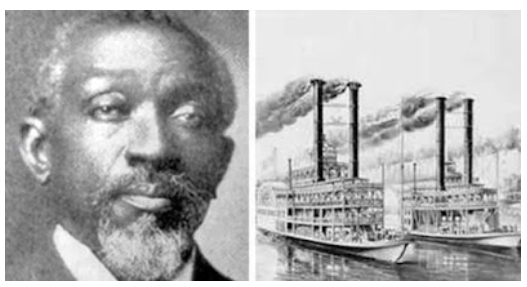
In the 1850’s Montgomery developed a better propeller for river steamboats.
Montgomery was born in London County, Virginia in 1819. From an early age, he demostrated that he was clever. However, he was born a slave, and didn’t learn to read and write until much later in life. But his literacy gave him the opportunity to learn land surveying and architectural drafting, and this led to him later becoming a successful engineer and inventor.
A matter of discrimination
Although there were Blacks at the time who managed to patent their inventions like Thomas L. Jennings of New York in 1821, the system wasn’t always fair or equal. In some instances to avoid discrimination, Black inventors would use white people as third parties to do it for them.
In the case of Montgomery, however, the circumstances were a lot different and more difficult. Joseph Holt, head of the Patent Office at the time, felt that a free Black man who escaped to the North simply did not have the right to patent an invention.
Read more of this article on Blackhistory.com.
Government
24th Amendment abolished poll tax,1864

Inventions
1922-1986. People who have breathing problems may, in the future, give credit to Rufus Stokes for helping to ease their problem. In 1968, Mr. Stokes was granted a patent on an air purification device which reduced the gases and ashes in smoke to a non-dangerous and invisible level.
This not only helps people, but also improves the health of plants and animals as well as improving the appearance and durability of buildings, cars and other things exposed to the air. After building and successfully testing several models of his machine, Mr. Stokes, in 1973, constructed a small domestic model and a large mobile model to show that his invention could be used in many ways.
Read more about Rufus Stokes on Wikipedia.
