
The Arts
Stowe’s landmark novel, Uncle Tom’s Cabin, has often been cited as one of the causes of the Civil War. She became outraged by written accounts of the injustice and cruelty of the slave system and traveled to the South to investigate it herself. The material she gathered became the source for Uncle Tom’s Cabin; or Life Among the Lowly. The book, which was first published in 1831 in serial form in an abolitionist newspaper, became an immediate sensation, soon gaining worldwide popularity. Stowe was also an ardent supporter of women’s rights, and she collaborated with her sister, Catherine Beecher, on nineteen domestic-science books.
The Arts
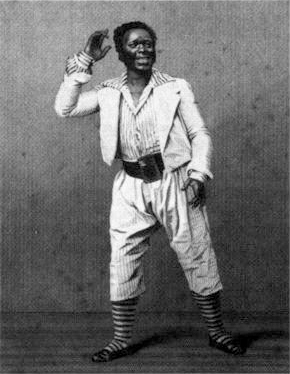
Ira Aldridge was born around 1805. His place of birth has been listed as Africa but more often Bel Air, Maryland. He was apprenticed as a carpenter under a German immigrant. Aldridge learned carpentry as well as German. Because of the lack of schools for African-Americans in Maryland, Aldridge moved to New York and attended the African Free School and Schenectady College. It was at Schenectady that Aldridge became interested in acting. He raised money and moved to Glasgow, Scotland.
He studied at the University of Glasgow, developing voice projection and dramatic skills. Aldridge was so gifted that by 1837 he was drawing crowds to see him portray Shakespearian roles. Aldridge was such a great actor that he performed for the president of the U.S., Queen Victoria and the Archduch of Chambory. He received many awards and was heavily decorated. Aldridge was even the first African-American to become a knight. He married twice and was divorced once. Aldridge died in Poland in 1867. At the Shakespearean Memorial Theatre in Stratford-On-Avon, England, a chair is dedicated to the memory of Ira Aldridge.

The Arts
Cabell Calloway III (December 25, 1907 – November 18, 1994) was an American jazz singer and bandleader. He was a regular performer at the Cotton Club in Harlem, where he became a popular vocalist of the swing era. His niche of mixing jazz and vaudeville won him acclaim during a career that spanned over 65 years.
Calloway was a master of energetic scat singing and led one of the most popular dance bands in the United States from the early 1930s to the late 1940s. His band included trumpeters Dizzy Gillespie, Jonah Jones, and Adolphus “Doc” Cheatham, saxophonists Ben Webster and Leon “Chu” Berry, guitarist Danny Barker, bassist Milt Hinton, and drummer Cozy Cole.
Calloway had several hit records in the 1930s and 1940s, becoming the first African-American musician to sell one million copies of a record. He became known as the “Hi-de-ho” man of jazz for his most famous song, “Minnie the Moocher”, originally recorded in 1931. He reached the Billboard charts in five consecutive decades (1930s–1970s). Calloway also made several stage, film, and television appearances until his death in 1994 at the age of 86. He had roles in Stormy Weather (1943), Porgy and Bess (1953), The Cincinnati Kid (1965), and Hello Dolly! (1967). His career enjoyed a marked resurgence from his appearance in the 1980 film The Blues Brothers.
Read more of this article on Wikipedia.

The Arts
Thelonious Sphere Monk (/θəˈloʊniəs/ October 10, 1917 – February 17, 1982) was an American jazz pianist and composer. He had a unique improvisational style and made numerous contributions to the standard jazz repertoire, including “‘Round Midnight”, “Blue Monk”, “Straight, No Chaser”, “Ruby, My Dear”, “In Walked Bud”, and “Well, You Needn’t”. Monk is the second-most-recorded jazz composer after Duke Ellington.
Monk’s compositions and improvisations feature dissonances and angular melodic twists, often using flat ninths, flat fifths, unexpected chromatic notes together, low bass notes and stride, and fast whole tone runs, combining a highly percussive attack with abrupt, dramatic use of switched key releases, silences, and hesitations.
Monk’s distinct look included suits, hats, and sunglasses. He also had an idiosyncratic habit during performances: while other musicians continued playing, Monk would stop, stand up, and dance for a few moments before returning to the piano. Monk is one of five jazz musicians to have been featured on the cover of Time (the others being Louis Armstrong, Dave Brubeck, Duke Ellington, and Wynton Marsalis).
Read more of this article on Wikipedia.
The Arts
byname of CHARLES BOLDEN (b. 1868, New Orleans, La., U.S.–d. Oct. 4, 1931, New Orleans), cornetist and semilegendary founding father of jazz. He was said by many jazz musicians, including the great trumpeter Louis Armstrong, to have been one of the most powerful musicians ever to play jazz.
Little is known about the details of Bolden’s career, but it is documented that he was a barber and that from 1895 to 1899 he led a band that included the cornetist Bunk Johnson. The acknowledged king of New Orleans lower musical life, Bolden often worked with six or seven different bands simultaneously. In 1906 his emotional stability began to crumble, and on June 5, 1907, he was committed to the East Louisiana State Hospital, from which he never emerged.

The Arts
DEREK ALTON WALCOTT (b. Jan. 23, 1930, Castries, Saint Lucia), West Indian poet and playwright noted for works that explore the Caribbean cultural experience. He received the Nobel Prize for Literature in 1992.
Walcott was of mixed black, Dutch, and English descent. He was educated at St. Mary’s College, St. Lucia, and at the University of the West Indies in Jamaica. He began writing poetry at an early age, taught at schools in St. Lucia and Grenada, and contributed articles and reviews to periodicals in Trinidad and Jamaica. Productions of his plays began in St. Lucia in 1950, and he studied theatre in New York City in 1958-59. He lived thereafter in Trinidad and the United States, teaching for part of the year at Boston University.
Walcott is best known for his poetry, beginning with In a Green Night: Poems 1948-1960 (1962). This book is typical of his early poetry in its celebration of the Caribbean landscape’s natural beauty. The verse in Selected Poems (1964), The Castaway (1965), and The Gulf (1969) is similarly lush in style and incantatory in mood as Walcott expresses his feelings of personal isolation, caught between his European cultural orientation and the black folk cultures of his native Caribbean. Another Life (1973) is a book-length autobiographical poem. In Sea Grapes (1976) and The Star-Apple Kingdom (1979), Walcott uses a tenser, more economical style to examine the deep cultural divisions of language and race in the Caribbean. The Fortunate Traveler (1981) and Midsummer (1984) explore his own situation as a black writer in America who has become increasingly estranged from his Caribbean homeland. Walcott’s Collected Poems, 1948-1984, was published in 1986.
Of Walcott’s approximately 30 plays, the best known are Dream on Monkey Mountain (produced 1967), Ti-Jean and His Brothers (1958), and Pantomime (1978). Many of his plays make use of themes from black folk culture in the Caribbean.
