Black History, The Arts
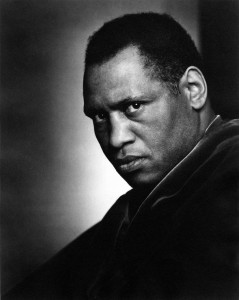
Paul Robeson
Paul Robeson was one of the most gifted men in the history of the world. He was an athlete, actor, author, attorney, a scholar and concert singer. Born in Princeton, New Jersey on April 9, 1898, Paul Robeson showed that he was a man of many talents. He gave 296 performances as Othello on Broadway.
He was subsequently recognized as an internationally famous singer and performed on concert stages throughout the world. Robeson spoke and performed in over twenty languages and dialects, and became a spokesman throughout the world against exploitation, injustice, and racism. His attacks on injustice and racism in the United States became a severe international embarrassment to the United States government. (more…)
Abolition, Black History
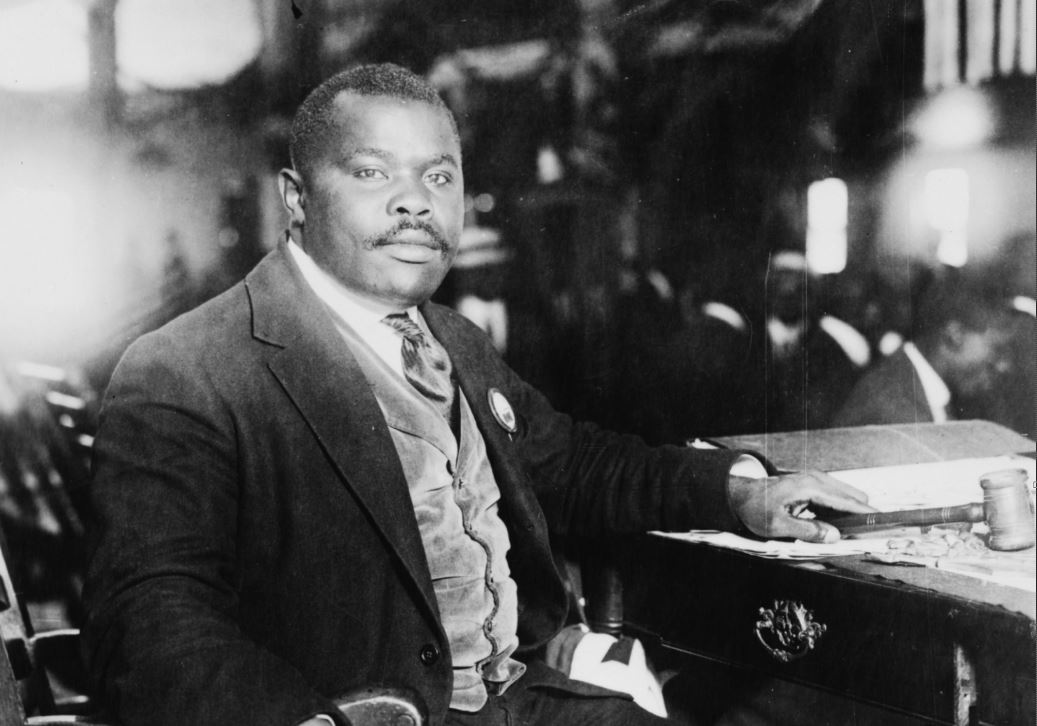
Marcus Garvey
Marcus Garvey (August 17, 1887 – June 10, 1940) and the Universal Negro Improvement Association (UNIA) form a critical link in black America’s centuries-long struggle for freedom, justice, and equality. As the leader of the largest organized mass movement in black history and progenitor of the modern “black is beautiful” ideal, Garvey is now best remembered as a champion of the back-to-Africa movement. In his own time he was hailed as a redeemer, a “Black Moses.” Though he failed to realize all his objectives, his movement still represents a liberation from the psychological bondage of racial inferiority. (more…)
Black History, Politics
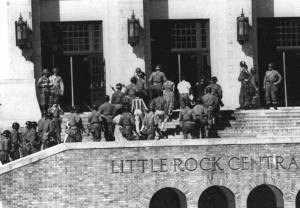
Desegregation at Little Rock: Little Rock Central High School. February 14. 1969
On October 29, 1969, the Supreme Court ruled that school districts must end segregation “now and hereafter.� With this unambiguous language, the Court, which now had Thurgood Marshall as a member, left no room for doubt or delay.Alexander v. Holmes County Board of Education is an important (and, today, curiously underrated) Supreme Court decision from 1969. It mandated immediate action in the segregation of public school facilities.
The Court was responding to a legal challenge from diehard anti-integrationists, who had learned—from civil rights proponents, no doubt—that the legal system could be used to support social objectives. The anti-integrationists, however, received a major defeat when the Court ruled unanimously that Mississippi (and, by extension, the nation) was obliged to integrate public schools “at once.â€� (more…)
Black History, Firsts, Law
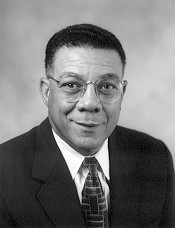
Reuben V. Anderson
Reuben V. Anderson was the 1st Black appointed to Mississippi Supreme Court.
African American civil rights lawyer, Anderson attended Tougaloo College and graduated from Ole Miss law school in 1967. Upon his graduation, he began working as the Mississippi associate counsel with the NAACP Legal Defense and Educational Fund Inc. until 1975. From 1981 to 1985, he served as judge in Hinds County Circuit Court.
Next, he was appointed to the Mississippi Supreme Court, a position he held until 1991.
Black History, Religion
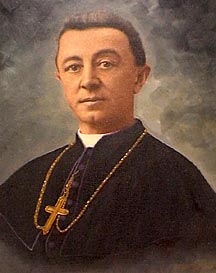
James Augustine Healy the first black bishop ordained in the U.S.
James Augustine Healy, was appointed February 12, 1875, and consecrated as Bishop of Portland (Maine) at the Cathedral of the Immaculate Conception (see Cathedral) on June 2, 1875. James Augustine Healy became the first black bishop ordained in the United States. He was the son of an Irish immigrant, Michael Healy, who became a prosperous plantation-owner in Georgia, and a mulatto woman who was actually a slave.
James was educated in northern schools and later attended the newly established Holy Cross College. There he made his decision to enter the priesthood. He furthered his studies in Montreal and Paris where he was ordained in 1854 at the Cathedral of Notre Dame. After ordination Father Healy was assigned to Bishop John Fitzpatrick’s Boston Diocese. He remained there serving first at the House of the Angel Guardian, then as Chancellor of the Diocese and finally as pastor of St. James Church. When his appointment came as the second Bishop of Portland, he was forty-five years old. (more…)