Black History, Other, Religion
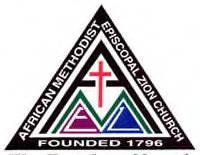 Eliza Ann Gardner is regarded as the “mother” of the African Methodist Episcopal Zion (AMEZ) Missionary Society and was one of New England’s most tenacious defenders of women’s equality in religious matters.
She was born in New York City on May 28, 1831, the daughter of James and Eliza Gardner. When she was young, the family moved to the predominantly black West End section of Boston, where her father enjoyed a profitable career as a contractor for sailing vessels. His work made it possible for Gardner to enjoy a comfortable childhood, but she quickly learned that many others of her race were less fortunate, and was taught that she had an obligation to help them. Her family was active in the local African Methodist Episcopal Church, and their home served as a station for the Underground Railroad, which smuggled runaway slaves from the South to freedom.
Gardner’s interest in slavery intensified because of her education at the only public school for black children in the city, which was taught by abolitionist teachers. As a result, she became acquainted with many nationally famous abolitionist leaders. An excellent student, Gardner earned a number of scholarships. However, as few black women at the time were able to pursue higher education or professional careers, she learned the art of dressmaking to support herself once she finished school. (more…)
Black History, Music
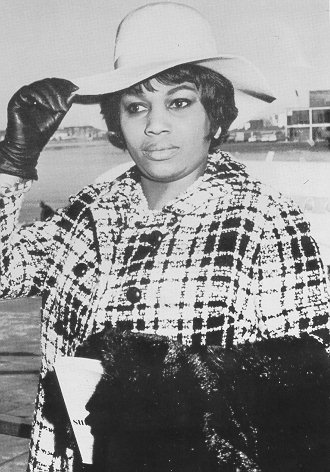
Leontyne Price
Soprano Leontyne Price was born Mary Violet Leontine Price in Laurel, Mississippi, on February 10, 1927, the daughter of James and Katherine Price. Leontine was a very musical child and became a local success at an early age, singing at local weddings and funerals. After receiving local training, she sang in her first recital on December 17, 1943.
After studying at Wilberforve College (now Central State University) in Ohio, Leontine enrolled in the Juilliard School of Music in New York. She began studying with Florence Page Kimball and, shortly after changing the spelling of her name to “Leontyne”, she was accepted into the Juilliard Opera Workshop. Much of Leontyne’s musical education was supported by a wealthy family from Laurel, Alexander and Elizabeth Chisolm.
At Juilliard, she appeared in 1952 as Nella in Gianni Schicchi and and, later that year, as Mistress Ford in Falstaff. Also in 1952, she was invited by composer Virgil Thompson to appear as Saint Cecilia in a revival of his Four Saints in Three Acts in New York and Paris. (more…)
Black History, Politics, Slavery
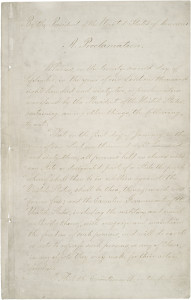
Emancipation Proclamation
President Abraham Lincoln issued the Emancipation Proclamation on January 1, 1863, as the nation approached its third year of bloody civil war. The proclamation declared “that all persons held as slaves” within the rebellious states “are, and henceforward shall be free.”
Despite this expansive wording, the Emancipation Proclamation was limited in many ways. It applied only to states that had seceded from the Union, leaving slavery untouched in the loyal border states. It also expressly exempted parts of the Confederacy that had already come under Northern control. Most important, the freedom it promised depended upon Union military victory.
Although the Emancipation Proclamation did not end slavery in the nation, it captured the hearts and imagination of millions of Americans and fundamentally transformed the character of the war. After January 1, 1863, every advance of federal troops expanded the domain of freedom. Moreover, the Proclamation announced the acceptance of black men into the Union Army and Navy, enabling the liberated to become liberators. By the end of the war, almost 200,000 black soldiers and sailors had fought for the Union and freedom. (more…)
Black History, Education

Peabody Education Fund
Founded of necessity due to damage caused largely by the American Civil War, the Peabody Education Fund was established by George Peabody in 1867 for the purpose of promoting “intellectual, moral, and industrial education in the most destitute portion of the Southern States.” The gift of foundation consisted of securities to the value of $2,100,000, of which $1,100,000 were in Mississippi State bonds, afterward repudiated. In 1869 an additional $1,000,000 was given by Mr. Peabody, with $384,000 of Florida funds, also repudiated later. The main purpose of the fund was to aid elementary education by strengthening existing schools. Because it was restricted from founding new schools, it did not benefit freedmen in the South, as there were no established schools for blacks.
“The fund introduced a new type of benefaction in that it was left without restriction in the hands of the trustees to administer. Power to close the trust after thirty years was provided on condition that two-thirds of the fund be distributed to educational institutions in the Southern states.” (more…)
Abolition, Black History
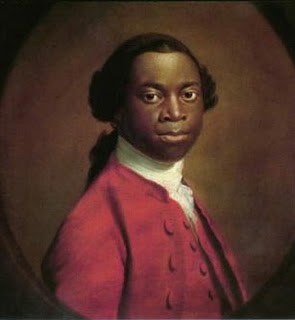
Olaudah Equiano
aka Gustavus Vassa
Captured far from the African coast when he was a boy of 11, Olaudah Equiano was sold into slavery, later acquired his freedom, and, in 1789, wrote his widely-read autobiography, The Interesting Narrative of the Life of Olaudah Equiano, or Gustavus Vassa, the African.
The youngest son of a village leader, Equiano was born among the Ibo people in the kingdom of Benin, along the Niger River. He was “the greatest favourite with [his] mother.” His family expected to follow in his father’s footsteps and become a chief, an elder, a judge. Slavery was an intregal part of the Ibo culture, as it was with many other African peoples. His family owned slaves, but there was also a continual threat of being abducted, of becoming someone else’s slave. This is what happened, one day, while Equiano and his sister were at home alone. (more…)