Black History, Inventions
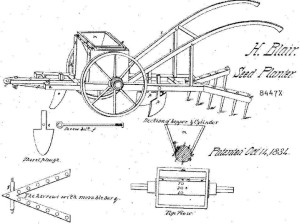
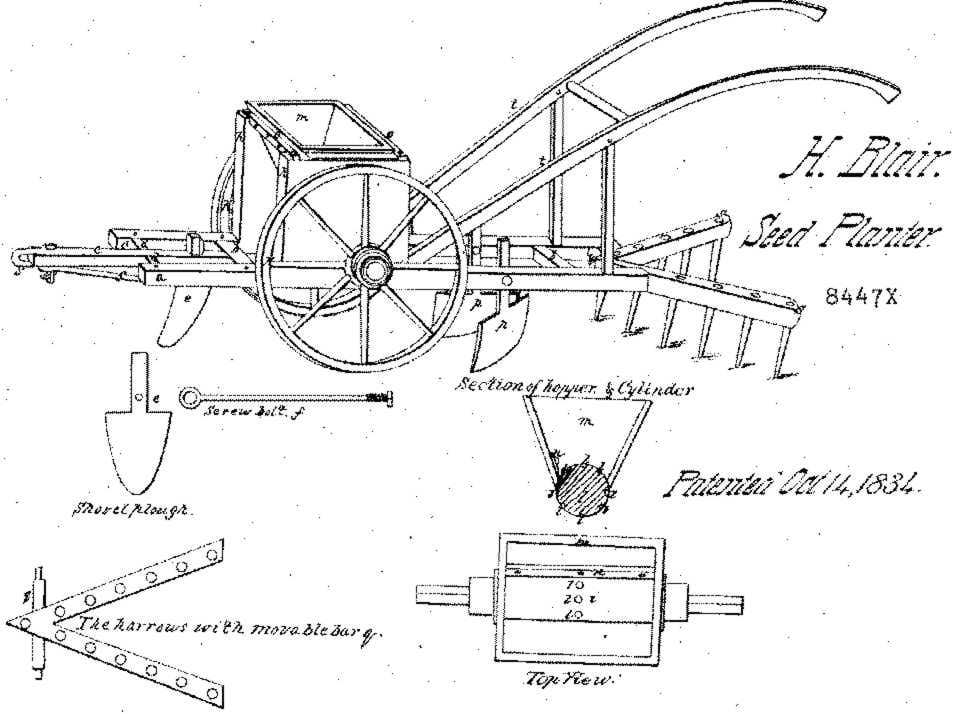
Henry Blair Seed planter
10-14-1834 marks one of the first patents filed by a Black person in America.
Henry Blair of Montgomery County, MD, received his first patent on October 14, 1834, for his invention of the corn seed planter, which allowed farmers to plant their corn much faster and with much less labor. The machine also helped with weed control. He later received another patent in 1836 for the invention of the cotton planter. The cotton planter was very similar to the seed planter in the way that it was put together.
Blair was not an educated man; he could not read or write. At the time that he filed his patent applications he had to sign them with an “x� because he was unable to write his name. Blair is the only person in the United States Patent Office records to be identified as a “colored man.� No other inventor is identified by his or her race. Henry Blair died in 1860.
Abolition, Black History
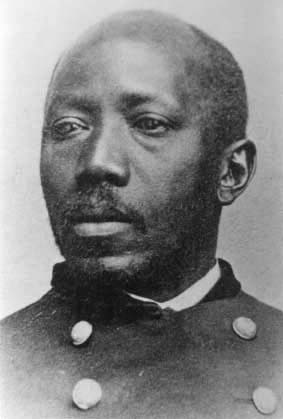
Martin R. Delaney
Martin Robison Delany (May 6, 1812 – January 24, 1885) was an African-American abolitionist, journalist, physician, soldier and writer, and arguably the first proponent of black nationalism.Delany is credited with the Pan-African slogan of “Africa for Africans.”
Born as a free person of color in Charles Town, Virginia (now in West Virginia) and raised in Chambersburg and Pittsburgh, Pennsylvania, Delaney trained as physician’s assistant. During the cholera epidemics of 1833 and 1854 in Pittsburgh, Delany treated patients although many doctors and residents fled the city out of fear of contamination. In this period, people did not know how the disease was transmitted.
In 1850, Delany was one of the first three black men admitted to Harvard Medical School, but all were dismissed after a few weeks because of widespread protests by white students. (more…)
Black History, Inventions

Joseph Lee
Joseph Lee was an African American who invented machinery for processing food and became very prominent in the food industry.
Lee was born in Boston, MA, and as a boy worked at a bakery. He soon began preparing, cooking and serving food, eventually opening two successful restaurants in the Boston area. In the late 1890s, Lee owned and managed the Woodland Park Hotel in Newton, MA, for 17 years. In 1902, as a way of maintaining an involvement in the food services industry, Lee opened a catering business called the Lee Catering Company that served the wealthy population of Boylston Street in the Back Bay. (more…)

Black History, Inventions, Science
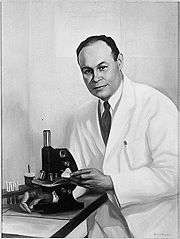
Illustration of Drew by Charles Alston in the collection of the National Archives
Charles Richard Drew (3 June 1904 – 1 April 1950) was an American physician, surgeon and medical researcher. He researched in the field of blood transfusions, developing improved techniques for blood storage, and applied his expert knowledge to developing large-scale blood banks early in World War II. This allowed medics to save thousands of lives of the Allied forces.
The research and development aspect of his blood storage work is disputed. As the most prominent African-American in the field, Drew protested against the practice of racial segregation in the donation of blood, as it lacked scientific foundation, an action which cost him his job. In 1943, Drew’s distinction in his profession was recognized when he became the first black surgeon selected to serve as an examiner on the American Board of Surgery.
Drew’s athletic achievements helped win him a scholarship to Amherst College in Massachusetts and he graduated in 1926. An outstanding athlete at Amherst, Drew also joined Omega Psi Phi fraternity. (more…)
Black History, Inventions

Benjamin Banneker
Born on November 9, 1731 near Elliott City, Maryland, Benjamin Banneker was one of America’s greatest intellectuals and scientists. Benjamin Banneker was an essayist, inventor, mathematician, and astronomer.
Because of his dark skin and great intellect he was called the “sable genius.” Benjamin Banneker was a self-taught mathematician and astronomer. While still a youth he made a wooden clock which kept accurate time past the date that Banneker died.
This clock is believed to be the first clock wholly made in America. In 1791, he served on a project to make a survey for the District of Columbia, helping to design the layout for our Nation’s capital. (more…)