Black History, Firsts, Government
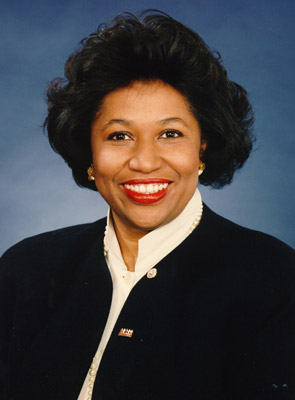
Carol Moseley-Braun
The first African-American woman Senator, Carol Moseley-Braun was also only the second black Senator since the Reconstruction Era. “I cannot escape the fact that I come to the Senate as a symbol of hope and change,” Moseley-Braun said shortly after being sworn in to office in 1993. “Nor would I want to, because my presence in and of itself will change the U.S. Senate.” During her single term in office, Senator Moseley-Braun advocated for civil rights issues and for legislation on crime, education, and families.
Carol Moseley was born in Chicago, Illinois, on August 16, 1947. Her parents, Joseph Moseley, a policeman, and her mother, Edna (Davie) Moseley, a medical technician, divorced in 1963. The oldest of the four Moseley children in a middle-class family, Carol graduated from Parker High School in Chicago and earned a B.A. in political science from the University of Illinois in 1969. (more…)
Black History, Slavery
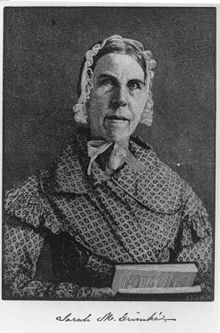
Sarah Moore Grimké
Sarah Grimke, along with her sister Angelina, were the first women in the United States to publicly argue for the abolition of slavery. Cultured and well educated, Sarah had gone north from South Carolina with her sister with firsthand knowledge of the condition of the slaves. In 1836 Angelina wrote a lengthy address urging all women to actively work to free blacks.
The sisters’ lectures elicited violent criticism because it was considered altogether improper for women to speak out on political issues. This made them acutely aware of their own oppression as women, which they soon began to address along with abolitionism. A severe split developed in the abolition movement, with some antislavery people arguing that it was the “Negro’s hour and women would have to wait.” (more…)
Black History, Firsts
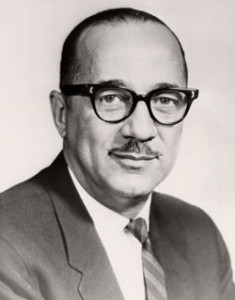
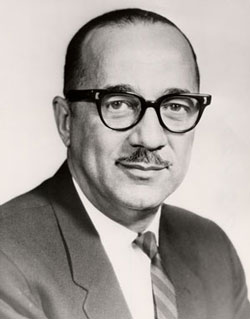
William Hastie
William Hastie had one of the most distinguished careers as an earlier Black political pioneer but today remains unknown to most Americans. As a politician, an educator and a jurist, Hastie made inroads and left a legacy that is hard to match in history.
William Hastie was born on November 17, 1904 in Knoxville, Tennessee, the son of William, a clerk in the United States Pension Office and Roberta, a school teacher. After the family moved to Washington D.C. in 1916, William attended Paul Lawrence Dunbar high school where he excelled as a student athlete and graduated as the school valedictorian in 1921. He attended Amherst College in Amherst, Massachusetts where he majored i mathematics. He graduated from the school in 1925 where he finished first in his class and graduated Phi Beta Kappa, Magna Cum Laude and the valedictorian of his class. After teaching for two years in Brodertown, New Jersey, he attended Harvard Law School where he was a member of the law review and graduated with an LL.B. in 1930. (more…)
Black History, Business
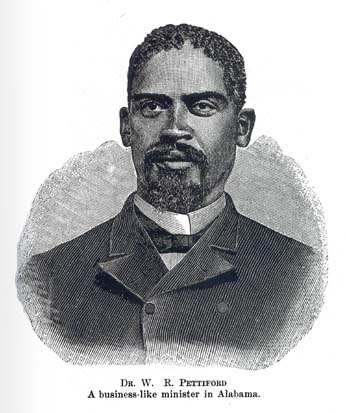
 The Penny Savings Bank, founded by Reverend William Reuben Pettiford in Birmingham in 1890, was the first black-owned and black-operated financial institution in Alabama. Created as a necessity of de facto and later codified segregation, the bank backed and encouraged development of black businesses, especially in urban areas, as well as savings by African Americans, until its closing in 1915.
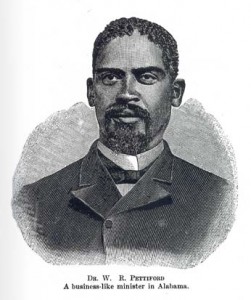
William Reuben Pettiford
William Reuben Pettiford was born to free parents in North Carolina in 1847. He moved to Alabama in 1869 to seek better educational and financial opportunities. After seven years of studying while holding down jobs, Pettiford completed his degree at the Lincoln Normal School (a predecessor of Alabama State University) in Marion, Perry County. In 1877, Pettiford became a teacher at Selma University and simultaneously entered the theological department of the school, taking courses from President Harrison Woodsmall.
Three years later, he voluntarily severed his connection with the school to become pastor of the First Baptist Church of Union Springs, where he also served as principal of the city school for African Americans. In 1883, he accepted the pastorate of the First Colored Baptist Church of Birmingham, later named the Sixteenth Street Baptist Church, at the urging of state Baptist leaders and educator Booker T. Washington, who assured him that he could provide necessary leadership for Birmingham’s expanding black population.
(more…)
Black History, Publishing
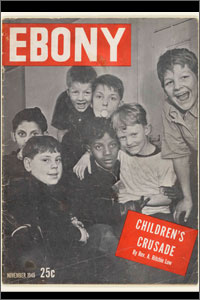
The first issue of Ebony magazine, Nov. 1, 1945.
On Nov. 1, 1945, America got its first look at Ebony, a monthly coffee-table magazine modeled after Look andLife but whose goals were to focus on the achievements of blacks from “Harlem to Hollywood� and to “offer positive images of blacks in a world of negative images.�
Founded by publisher John H. Johnson, Ebony’s first cover ironically did not feature a glamorous black entertainer or an African-American “first� but seven boys — six of them white — from a program to improve race relations. The first issue sold out at 25, 000 copies. Circulation peaked at nearly 2 million in 1997.
In addition to the fashion and beauty stories that continue to be Ebony mainstays, the magazine also tackled civil rights, education and black entrepreneurship, stories important to the black community that mainstream publications often ignored.
Through the lens of longtime Ebony photographer Moneta Sleet who died in 1996, Ebonywas at the forefront of some of the most important stories in history. (more…)