Abolition
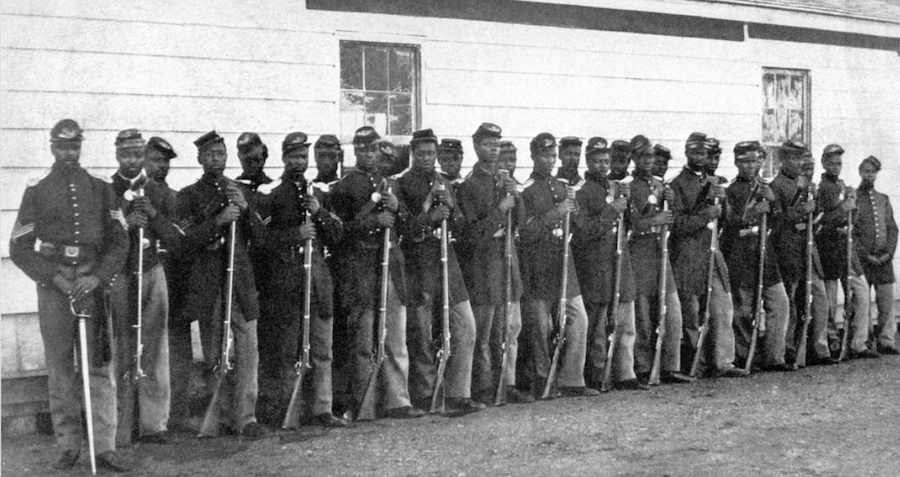
The 54th Regiment Massachusetts Infantry was a volunteer Union regiment organized in the American Civil War. Its members became known for their bravery and fierce fighting against Confederate forces. It was the second all-Black Union regiment to fight in the war, after the 1st Kansas Colored Volunteer Infantry Regiment.
From the beginning of the Civil War, President Abraham Lincoln argued that the Union forces were not fighting to end slavery but to prevent the disintegration of the United States. For abolitionists, however, ending slavery was the reason for the war, and they argued that Black people should be able to join the fight for their freedom. However, African Americans were not allowed to serve as soldiers in the Union Army until January 1, 1863. On that day, the Emancipation Proclamation decreed that “such persons [that is, African American men] of suitable condition, will be received into the armed services of the United States.”
Early in February 1863, the abolitionist Governor John A. Andrew of Massachusetts issued the Civil War’s first call for Black soldiers. Massachusetts did not have many African American residents, but by the time 54th Infantry regiment headed off to training camp two weeks later more than 1,000 men had volunteered. Many came from other states, such as New York, Indiana and Ohio; some even came from Canada. One-quarter of the volunteers came from slave states and the Caribbean. Fathers and sons (some as young as 16) enlisted together. The most famous enlistees were Charles and Lewis Douglass, two sons of the abolitionist Frederick Douglass.
Read more of this article on the History Channel.
Government
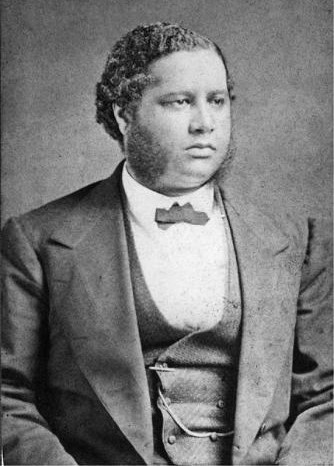
Francis L. Cardoza was elected State Treasurer of South Carolina in 1858.
Francis Lewis Cardozo was a minister, educator, and politician who was born free in Charleston, South Carolina, on February 1, 1836. Cardozo was of mixed ancestry, as his father, Isaac Nunez Cardozo, was a Sephardic Jew, and his mother, Lydia Williams Weston, was a free woman of color. South Carolina laws did not allow for interracial marriages, so the couple’s union was considered a common-law marriage. The couple had five children, three boys and two girls. Cardozo and his brothers were sent to a private school for children of color.
At the end of his schooling, Cardozo worked as a carpenter and shipbuilder. In 1858, he used his savings to pay his way on a ship headed to Scotland and enrolled at the University of Glasgow, where he began to study Greek and Latin. He studied at Edinburgh Theological and London seminaries and was an ordained Presbyterian minister when he returned to the United States in 1864. Cardozo became the pastor of the Temple Street Congregational Church in New Haven, Connecticut, and married Catherine Rowena Howell on December 20, 1864. The couple had six children.
Cardozo returned to Charleston in 1865 as an agent for the American Missionary Association (AMA), founded in 1846 by an abolitionist group from Albany, New York. He worked as the superintendent of an AMA-established school and was responsible for its transformation into The Avery Normal Institute. The institute focused on training Black teachers. Cardozo, a member of the Republican Party, became involved in Reconstruction politics. By 1868, he was selected as a delegate to the South Carolina State Constitutional Convention, where he chaired the education committee. He called for the dissolution of the plantation system and racially integrated schools. Cardozo’s speech led to his election as the first Black Secretary of State in South Carolina’s history later in 1868.
Read more of this article on BlackPast.org.
Government
24th Amendment abolished poll tax,1864
Abolition
A twenty eight year-old man who “was tall, and well-made, and possessed of a considerable share of intelligence.” After being whipped severely by his master and hearing of being auctioned off in the near future, Ford decided to enlist the help of the committee running the Underground Rail Road in order to escape his dismal fate. Still recounts Ford’s flight to freedom:
The first day of the woods he passed in prayer incessantly, all alone. In this particular place of seclusion he reamined “four days and nights,” “two days suffered severely from hunger, cold and thrist.” However, one who was a “friend” to him, and knew his whereabouts, managed to to get some food to him and consoling words; but at the end of the four days this friend got inot some difficulty and thus Sheridan was left to “wade through deep waters and head winds” in an almost hopeless state. There he could not consent to stay and starve to death. Accordingly, he left and found another place od seclusion-with a friend in the town- for a pecuniary consideration. A secret passage was procured for him on one of the steamers running between Philadelphia and Richmond, Va. When he left his poor wife, Julia, she was then “lying in prison to be sold,” on the simple charge of having been suspected of conniving at her husband’s escape. As a woman she had known something of the “barbarism of slavery,” from every-day experience, which the large scars about her head indicated-according to Sheridan’s testimony. She was the mother of two children, but had never been allowed to have the care of either of them. The husband, utterly powerless to offer the least sympathy in word or deed, left his dark habitation of cruelty, as above referred to, with no hope of ever seeing wife or child again in this world.
Education
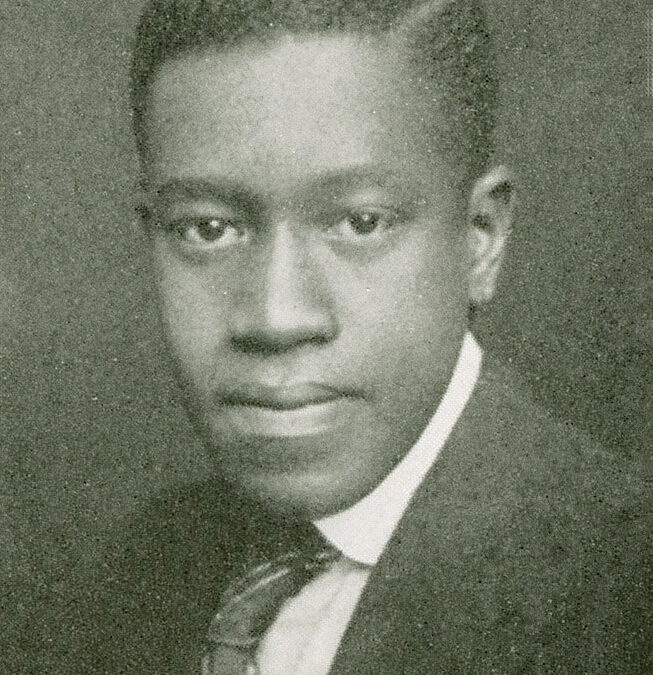
Elbert Frank Cox was born in Evansville, Indiana, in December 1895. He earned the baccalaureate degree from the University of Indiana in 1917 with a major in mathematics. After serving in the US Army in France during World War I, he returned to pursue a career in teaching. Before enrolling in the graduate mathematics program at Cornell University in September 1922, he taught mathematics in the public schools in Henderson, Kentucky and later at Shaw University in Raleigh, North Carolina. In 1925 he was awarded the Doctor of Philosophy degree in mathematics from Cornell and thus, he is the first known Black to receive the Ph.D. in Mathematics in the United States; in fact, in the world.
Cox’s thesis advisor was William Lloyd Garrison Williams, a McGill University mathematics professor from 1924-1952. Before arriving at McGill University, Williams taught at Cornell University, where he met Cox.; Despite having only a bachelor’s degree in mathematics, Cox had shown outstanding ability as an instructor at North Carolina’s Shaw University, thereby earning the Erastus Brooks Fellowship that allowed him to pursue his Ph.D. at Cornell. The two mathematicians became life-long friends and Williams arranged for Cox to come to Montreal for the final stages of his dissertation on the properties of difference equations.
When Williams realized that Cox had the chance to be recognized not only as the first Black in the United States, but as the first Black in the world to receive a Ph.D. in mathematics, he urged his student to send his thesis to a university in another country so that Cox’s status in this regard would not be disputed. Universities in England and Germany turned Cox down (possible for reasons of race), but Japan’s Imperial University of San Deigo accepted the dissertation.
In September 1925, Cox accepted a teaching position at West Virginia State College. He stayed there four year and in 1929 moved to Howard University. Cox remained at Howard until his retirement in 1965 and served as chairman of the Mathematics Department from 1957-1961. In 1975, the Howard University Mathematics Department, at the time of the inauguration of the Ph.D. program, established the Elbert F. Cox Scholarship Fund for undergraduate mathematics majors to encourage young Black students to study mathematics at the graduate level.
While Cox did not live to see the inauguration of the Ph.D. program at Howard, it is believed by many that Cox did much to make it possible. Cox helped to build up the department to the point that the Ph.D. program became a practical next step. He gave the department a great deal of credibility; primarily because of this personal prestige as a mathematician, as being the first Black to receive a Ph.D. in mathematics, because of the nature and kinds of appointments to the faculty that were made while he chaired the Department, and because of the kinds of students that he attracted to Howard to study mathematics at both the undergraduate and graduate (master’s) levels. Cox’s portrait hangs in Howard’s Mathematics Common Room as a reminder of his contribution to the Mathematics Department, the University, and the Community of scholars in general.
In 1980, the National Association of Mathematicians (NAM) honored Cox with the inauguration of the Cox-Talbot Address which is given annually at NAM’s National Meeting.
