
Arts
b. 1915
Born in Washington, D.C., Elizabeth Catlett studied art under Grant Wood at the University of Iowa, then taught at Hampton University in Virginia. She married artist Charles White in 1941. They lived in New
York, where they mingled with other intellectuals and artists, including Jacob Lawrence and Langston Hughes.
In 1946 Catlett received a Rosenwald Fellowship, and she and White visited Mexico, where they studied painting, sculpture, and lithography and worked with Taller de Grafica Popular, a socially active artists’ collective. The following year they divorced, but Catlett remained in Mexico City, working with some of the most distinguished printmakers of the city. In 1962, she married painter-engraver Francisco Mora and made Mexico her home.
Today, Catlett continues to express a profound concern for the plight of women and the poor through her paintings and sculptures in marble, wood, and terra-cotta.

Medicine
(b. Jan. 18, 1858, Hollidaysburg, Pa.–d. Aug. 4, 1931, Idlewild, Mich.), American physician and founder of Provident Hospital in Chicago, credited with the first successful heart surgery.
Williams graduated from Chicago Medical College in 1883. He served as surgeon for the South Side Dispensary (1884-92) and physician for the Protestant Orphan Asylum (1884-93). In response to the lack of opportunity for blacks in the medical professions, he founded (1891) the nation’s first interracial hospital, Provident, to provide training for black interns and the first school for black nurses in the United States. He was a surgeon at Provident (1892-93, 1898-1912) and surgeon in chief of Freedmen’s Hospital, Washington, D.C. (1894-98), where he established another school for black nurses.
It was at Provident Hospital that Williams performed daring heart surgery on July 10, 1893. Although contemporary medical opinion disapproved of surgical treatment of heart wounds, Williams opened the patient’s thoracic cavity without aid of blood transfusions or modern anesthetics and antibiotics. During the surgery he examined the heart, sutured a wound of the pericardium (the sac surrounding the heart), and closed the chest. The patient lived at least 20 years following the surgery. Williams’ procedure is cited as the first recorded repair of the pericardium; some sources, however, cite a similar operation performed by H.C. Dalton of St. Louis in 1891.
Williams later served on the staffs of Cook County Hospital (1903-09) and St. Luke’s Hospital (1912-31), both in Chicago. From 1899 he was professor of clinical surgery at Meharry Medical College in Nashville, Tenn., and was a member of the Illinois State Board of Health (1889-91). He published several articles on surgery in medical journals. Williams became the only black charter member of the American College of Surgeons in 1913.
Civil Rights
Raised in abolitionist traditions by his minister father, A. Philip Randolph mirrored those beliefs for more than 60 years as a champion of equal rights. He came to national prominence by organizing the Brotherhood of Sleeping Car Porters and achieved the first union contract signed by a white employer and an African American labor leader (in 1937). In 1941 he conceived a march on Washington, DC, to protest exclusion of African American workers from defense jobs. Faced with the public relations threat of 100,000 marchers, President Franklin Roosevelt established the wartime Fair Employment Practice Committee. Randolph founded the League for Nonviolent Civil Disobedience Against Military Segregation, which in 1948 pressured President Harry Truman into ending segregation in the armed forces. Although in later years he became less militant, Randolph was a dedicated socialist from his college days in New York. His lifelong belief in unionism and integration flowed from that philosophy, and he went into action in 1917 by co-founding The Messenger, a weekly magazine of African-American protest, and lecturing across the country. For his outspoken leadership, Randolph’s opponents characterized him as “the most dangerous Negro in America” because of his proven power to create change. He was still the acknowledged patriarch into the early 1970s and into his 80s, after his key role in organizing the historic, 250,000 strong March on Washington in 1963.
The Arts
Dumas, Alexandre (1802-1870), was a Black novelist and playwright of the romantic period in France, known as Dumas p
The Arts
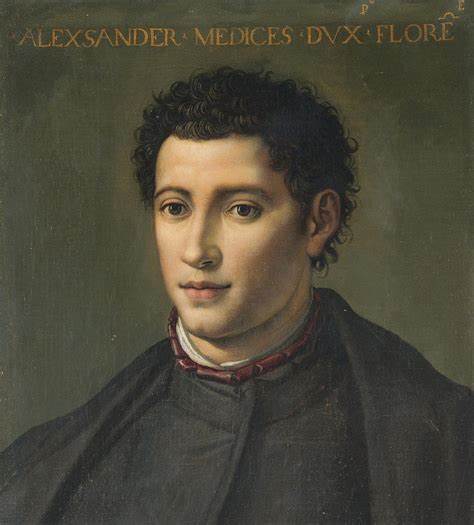
The House of Medici is credited with helping to usher in the European Renaissance, mostly through the efforts of Catherine De’ Medici, to promote the arts. Alessandro, the Duke of Florence, was questionable yet nevertheless a direct part of this great Dynasty.
Historical records are unclear regarding how the illegitimate Alessandro came into this distinguished family. How he became the Duke is also puzzling. It is thought to be the result of a political scheme concocted by Emperor Charles V and Pope Clement VII, who was widely rumored to be his father.
Alessandro was likely the son of a servant named Simonetta, who was employed by the Medici’s in Rome. He married Margaret, daughter of Charles V, but no children were born from this union. Howerver, according to anthrophotojournalist Joel Augustus Rogers, Alessandro did father several children who eventually married into Europe’s aristocracy.
As Duke, Alessandro is remembered for paying special attention not only to his rich supporters but to his peasant constituents as well, and he showed great interest in the arts. Apparently he had his enemies. He remained wary during his short reign, cautiously ordering the confiscation of all weapons in the city, as if he knew of his impending murder. On January 5, 1537, Alessandro was assassinated by his cousin Lorenzino. His death was later avenged by his successor, Cosimo I.
