Black History, The Arts
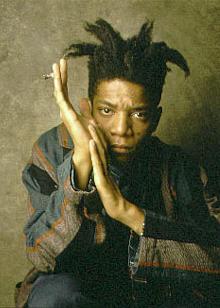
Jean-Michel Basquiat
b. Brooklyn, N.Y. Born into a middle-class Haitian and Puerto Rican family, he was a 1980s art star whose rise and fall were rapid and dramatic. A rebel, high school dropout, and part of the downtown New York scene, he was influenced by the violence of street life and by the life and work of Andy Warhol, who became his mentor.
Basquiat started as a graffiti artist, making images and writing slogans on the walls of buildings, and also produced painted T-shirts, found-object assemblages, and paintings.
In the early 1980s he was ‘discovered’ by the art establishment, and his works in paint and crayon on unprimed canvas, featuring crude, angry, and rawly powerful figures and graffiti-like written messages, were much sought after by collectors.
Basquiat’s art focused on “suggestive dichotomies,” such as wealth versus poverty, integration versus segregation, and inner versus outer experience. Basquiat appropriated poetry, drawing and painting, and married text and image, abstraction and figuration, and historical information mixed with contemporary critique. (more…)
Black History, Education
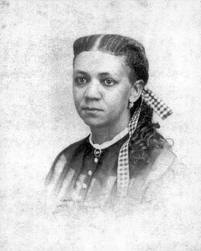
Fannie M. Jackson Coppin
Fannie M. Jackson Coppin, was not only the first black woman to graduate from college in the United States, but she was also the first woman to head a coeducation institute of learning in the United States. She enjoyed a long administration in which she managed to make many positive changes for the students at the Philadelphia Institute for Colored Youth(ICY) later to be known as Cheyney University.
Fannie managed to do away with corporal punishment and she established a dialogue between the school and the parents making them more involved in the schooling of their children. She initiated monthly report cards that reported not only grade marks but conduct marks as well. (more…)
Black History, Politics
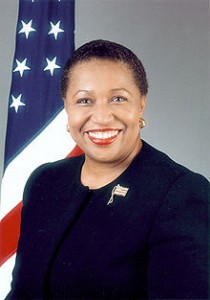
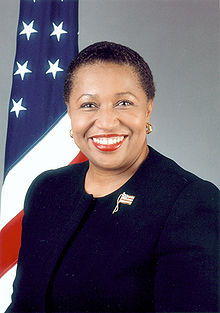
Carol Moseley Braun
CAROL MOSELEY (b. Aug. 16, 1947, Chicago, Ill., U.S.), U.S. senator from Illinois who, in 1992, became the first African-American woman elected to the U.S. Senate. Moseley-Braun attended the University of Illinois at Chicago and received a law degree from the University of Chicago.
She worked as an assistant U.S. attorney before her election to the Illinois House of Representatives in 1978. During her 10 years there she became known for her advocacy of health-care and education reform and gun control. She was named assistant leader for the Democratic majority.
In 1988-92 Moseley-Braun served as Cook county recorder of deeds. Displeased with U.S. Senator Alan Dixon’s support of U.S. Supreme Court nominee Clarence Thomas, she ran against Dixon in the 1992 Democratic primary. Though poorly financed, she won an upset victory over Dixon on her way to capturing a seat in the Senate. (more…)

Black History, Inventions, Other
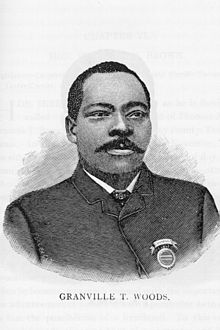
The Black Thomas Edison
Granville T. Woods (April 23, 1856 – January 30, 1910), was an African-American inventor who held more than 60 patents. Most of his work was on trains and street cars. Woods also invented the Multiplex Telegraph, a device that sent messages between train stations and moving trains. Born in Columbus, Ohio, on April 23, 1856, Granville T. Woods dedicated his life to developing a variety of inventions relating to the railroad industry.
Granville T. Woods literally learned his skills on the job. Attending school in Columbus until age 10, he served an apprenticeship in a machine shop and learned the trades of machinist and blacksmith. During his youth he also went to night school and took private lessons. Although he had to leave formal school at age ten, Woods realized that learning and education were essential to developing critical skills that would allow him to express his creativity with machinery.
In 1872, Woods obtained a job as a fireman on the Danville and Southern Railroad in Nebraska, eventually becoming an engineer. He invested his spare time in studying electronics. (more…)
Black History, Inventions
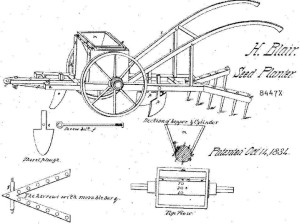
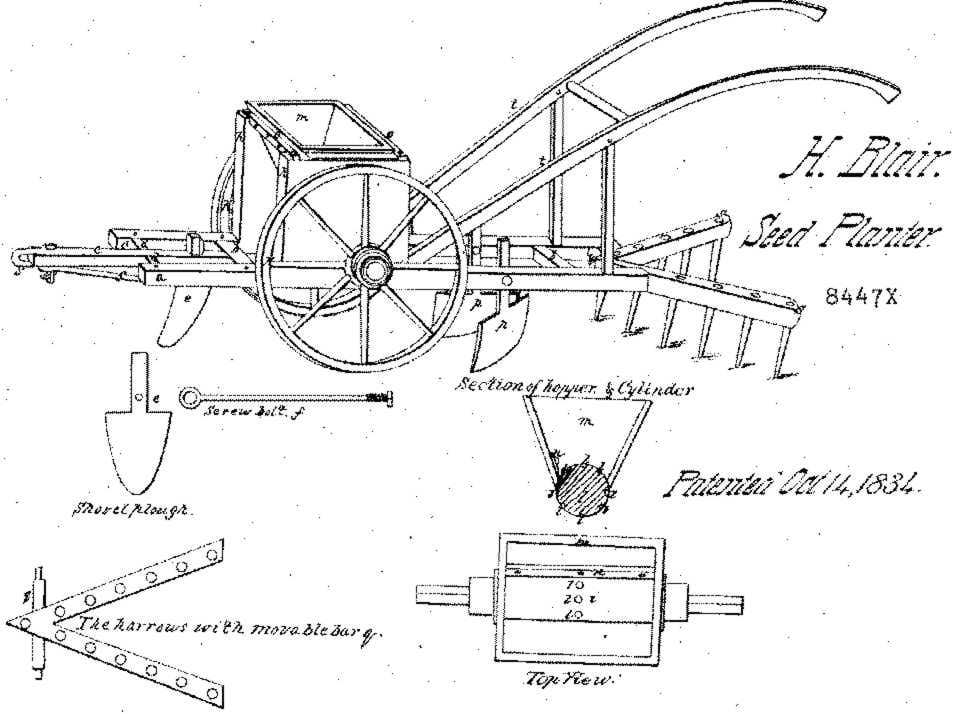
Henry Blair Seed planter
10-14-1834 marks one of the first patents filed by a Black person in America.
Henry Blair of Montgomery County, MD, received his first patent on October 14, 1834, for his invention of the corn seed planter, which allowed farmers to plant their corn much faster and with much less labor. The machine also helped with weed control. He later received another patent in 1836 for the invention of the cotton planter. The cotton planter was very similar to the seed planter in the way that it was put together.
Blair was not an educated man; he could not read or write. At the time that he filed his patent applications he had to sign them with an “x� because he was unable to write his name. Blair is the only person in the United States Patent Office records to be identified as a “colored man.� No other inventor is identified by his or her race. Henry Blair died in 1860.
Abolition, Black History
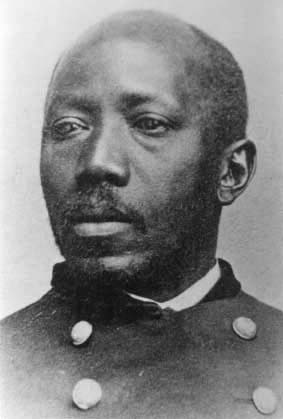
Martin R. Delaney
Martin Robison Delany (May 6, 1812 – January 24, 1885) was an African-American abolitionist, journalist, physician, soldier and writer, and arguably the first proponent of black nationalism.Delany is credited with the Pan-African slogan of “Africa for Africans.”
Born as a free person of color in Charles Town, Virginia (now in West Virginia) and raised in Chambersburg and Pittsburgh, Pennsylvania, Delaney trained as physician’s assistant. During the cholera epidemics of 1833 and 1854 in Pittsburgh, Delany treated patients although many doctors and residents fled the city out of fear of contamination. In this period, people did not know how the disease was transmitted.
In 1850, Delany was one of the first three black men admitted to Harvard Medical School, but all were dismissed after a few weeks because of widespread protests by white students. (more…)