Black History, Firsts
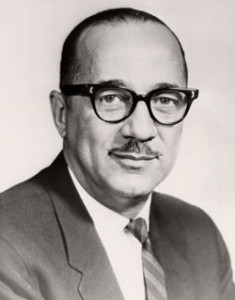
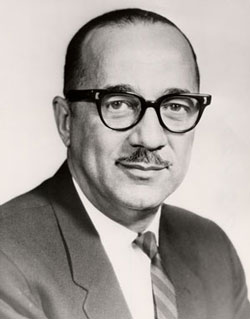
William Hastie
William Hastie had one of the most distinguished careers as an earlier Black political pioneer but today remains unknown to most Americans. As a politician, an educator and a jurist, Hastie made inroads and left a legacy that is hard to match in history.
William Hastie was born on November 17, 1904 in Knoxville, Tennessee, the son of William, a clerk in the United States Pension Office and Roberta, a school teacher. After the family moved to Washington D.C. in 1916, William attended Paul Lawrence Dunbar high school where he excelled as a student athlete and graduated as the school valedictorian in 1921. He attended Amherst College in Amherst, Massachusetts where he majored i mathematics. He graduated from the school in 1925 where he finished first in his class and graduated Phi Beta Kappa, Magna Cum Laude and the valedictorian of his class. After teaching for two years in Brodertown, New Jersey, he attended Harvard Law School where he was a member of the law review and graduated with an LL.B. in 1930. (more…)
Black History, Business
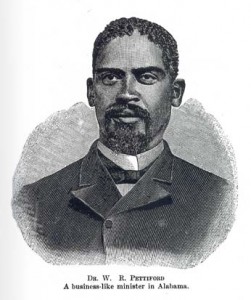 The Penny Savings Bank, founded by Reverend William Reuben Pettiford in Birmingham in 1890, was the first black-owned and black-operated financial institution in Alabama. Created as a necessity of de facto and later codified segregation, the bank backed and encouraged development of black businesses, especially in urban areas, as well as savings by African Americans, until its closing in 1915.
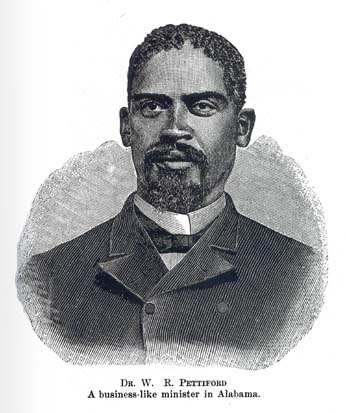
William Reuben Pettiford
William Reuben Pettiford was born to free parents in North Carolina in 1847. He moved to Alabama in 1869 to seek better educational and financial opportunities. After seven years of studying while holding down jobs, Pettiford completed his degree at the Lincoln Normal School (a predecessor of Alabama State University) in Marion, Perry County. In 1877, Pettiford became a teacher at Selma University and simultaneously entered the theological department of the school, taking courses from President Harrison Woodsmall.
Three years later, he voluntarily severed his connection with the school to become pastor of the First Baptist Church of Union Springs, where he also served as principal of the city school for African Americans. In 1883, he accepted the pastorate of the First Colored Baptist Church of Birmingham, later named the Sixteenth Street Baptist Church, at the urging of state Baptist leaders and educator Booker T. Washington, who assured him that he could provide necessary leadership for Birmingham’s expanding black population.
(more…)
Black History, Publishing
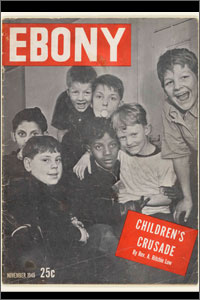
The first issue of Ebony magazine, Nov. 1, 1945.
On Nov. 1, 1945, America got its first look at Ebony, a monthly coffee-table magazine modeled after Look andLife but whose goals were to focus on the achievements of blacks from “Harlem to Hollywood� and to “offer positive images of blacks in a world of negative images.�
Founded by publisher John H. Johnson, Ebony’s first cover ironically did not feature a glamorous black entertainer or an African-American “first� but seven boys — six of them white — from a program to improve race relations. The first issue sold out at 25, 000 copies. Circulation peaked at nearly 2 million in 1997.
In addition to the fashion and beauty stories that continue to be Ebony mainstays, the magazine also tackled civil rights, education and black entrepreneurship, stories important to the black community that mainstream publications often ignored.
Through the lens of longtime Ebony photographer Moneta Sleet who died in 1996, Ebonywas at the forefront of some of the most important stories in history. (more…)
Black History, Politics
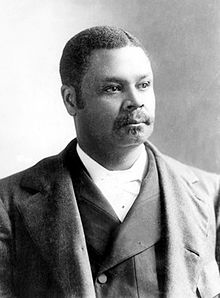
George H. White
George Henry White (18 Dec. 1852-28 Dec. 1918), lawyer, legislator, congressman, and racial spokesman, was born near Rosindale in Bladen County, the son of Wiley F. and Mary White. It is possible that he was born into slavery, although the evidence on this is contradictory. He did attend public schools in North Carolina and received training under D. P. Allen, president of the Whitten Normal School in Lumberton.
In 1876 he was an assistant in charge of the exhibition mounted by the U.S. Coast Survey at the Centennial Exhibition in Philadelphia. After graduation from Howard University in 1877, he was principal of the Colored Grade School, the Presbyterian parochial school, and the State Normal School in New Bern. He studied law under Judge William J. Clarke and received a license to practice in North Carolina in 1879. (more…)
Black History, Business, Firsts
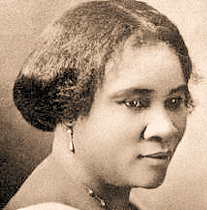
Madame C.J. Walker
Born Sarah Breedlove on December 23, 1867 on a Delta, Louisiana plantation, this daughter of former slaves transformed herself from an uneducated farm laborer and laundress into one of the twentieth century’s most successful, self-made women entrepreneurs.
Orphaned at age seven, she often said, “I got my start by giving myself a start.” She and her older sister, Louvenia, survived by working in the cotton fields of Delta and nearby Vicksburg, Mississippi. At 14, she married Moses McWilliams to escape abuse from her cruel brother-in-law, Jesse Powell.
Her only daughter, Lelia (later known as A’Lelia Walker) was born on June 6, 1885. When her husband died two years later, she moved to St. Louis to join her four brothers who had established themselves as barbers. (more…)
Black History, Law
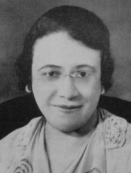
Violette N. Anderson
Violette N. Anderson was born July 16, 1882, in London, England. She and her parents, Richard and Marie Neatley, emigrated to the United States while Violette was a young girl, settling in Chicago. Violette graduated from Chicago’s North Division High School in 1899, then worked as a court reporter from 1905-1920.
She was fascinated by law and determined to become an attorney herself. She attended post-secondary school at the Chicago Seminar of Sciences from 1912-1915, and earned her LLB (a more advanced law degree than the typical JD) from Chicago Law School in 1920.
Violette Neatley Anderson became the first female Chicago City prosecutor in 1922, then established a successful legal practice in the Chicago area two years later. On January 29, 1926, she became the first African-American woman admitted to the US Supreme Court bar, but never argued a case before the Court. (more…)