Black History, Civil Rights, Other

Watts Burns
The Watts Riots (or Watts Rebellion) took place in the Watts neighborhood of Los Angeles from August 11 to 17, 1965. The six-day riot resulted in 34 deaths, 1,032 injuries, 3,438 arrests, and over $40 million in property damage. It was the most severe riot in the city’s history until the Los Angeles riots of 1992.
In the Great Migration of the 1920s, major populations of African-Americans moved to Northern cities like Detroit, Chicago, and New York City to escape racial segregation, Jim Crow Laws, violence, and racial bigotry in the Southern States. This wave of migration largely bypassed Los Angeles. In the 1940s, in the Second Great Migration, black Americans migrated to the West Coast in large numbers, in response to defense industry recruitment at the start of World War II. The black population in Los Angeles leaped from approximately 63,700 in 1940 to about 350,000 in 1965, making the once small black community visible to the general public.
Black History, Military
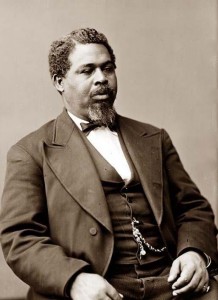
Robert Smalls
(b. April 5, 1839, Beaufort, S.C., U.S.–d. Feb. 22, 1915, Beaufort), Negro slave who became a naval hero for the Union in the American Civil War (1861-65) and went on to serve as a congressman from South Carolina during Reconstruction (1865-77).
The son of plantation slaves, Smalls was taken by his master in 1851 to Charleston, S.C., where he worked as a hotel waiter, hack driver, and rigger. Impressed into the Confederate Navy at the outbreak of the war, he was forced to serve as wheelman aboard the armed frigate “Planter.” On May 13, 1862, he and 12 other slaves seized control of the ship in Charleston harbour and succeeded in turning it over to a Union naval squadron blockading the city. This exploit brought Smalls great fame throughout the North. He continued to serve as a pilot on the “Planter” and became the ship’s captain in 1863. (more…)
Black History, Law, Slavery
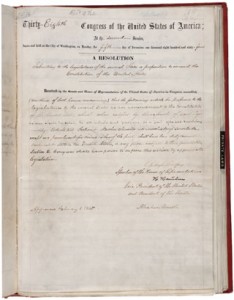 Passed by Congress on January 31, 1865, and ratified on December 6, 1865, the 13th amendment abolished slavery in the United States.
AMENDMENT XIII
SECTION 1.
Neither slavery nor involuntary servitude, except as a punishment for crime whereof the party shall have been duly convicted, shall exist within the United States, or any place subject to their jurisdiction.
SECTION 2.
Congress shall have power to enforce this article by appropriate legislation.
Black History, Inventions
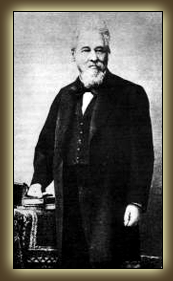
Norbert Rillieux
Norbert Rillieux was born on March 17, 1806 in New Orleans, Louisiana. Norbert was born a free man, although his mother was a slave. His father was a wealthy White engineer involved in the cotton industry. As a child Norbert was educated in the Catholic school system in New Orleans but was sent to Paris, France for advanced schooling.
He studied at the L’Ecole Centrale, the top engineering school in the country and at age 24 became an instructor of applied mechanics at the school, the youngest person to achieve this position. He published a series of papers related to “the Functions and Economic Implications of the Steam Engine.” Eventually, in 1834, Rillieux returned home to his father’s plantation which was now also being used to process and refine sugar.
(more…)
Black History, Literature
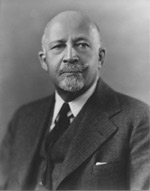
W.E.B. DuBoise
(b. February 23, 1868, Great Barrington, Mass.; d. August 27, 1963, Accra, Ghana), writer, social scientist, critic, and public intellectual; cofounder of the Niagara Movement, the National Association for the Advancement of Colored People (NAACP), and the Pan-African Congress; editor of the NAACP magazine, The Crisis.
Along with Frederick Douglass and Booker T. Washington, historians consider W. E. B. Du Bois one of the most influential African Americans before the Civil Rights Movement of the 1960s. Born only six years after emanicipation, Du Bois was active well into his nineties, dying in 1963, on the eve of the March on Washington. (more…)
Black History, Literature
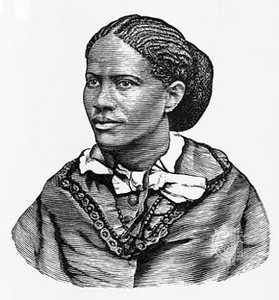
Frances Ellen Watkins Harper
Frances Ellen Watkins Harper was born on September 24, 1825 to free parents. A few years later, she was orphaned. Harper received her education at a school for free African-Americans run by her uncle, William Watkins. The school was located at the present day site of the Baltimore Convention Center.
At the age of 13, Harper’s formal education came to an end when she took a job as a nursemaid.
Harper’s first publication was a collection of poetry and prose entitled Autumn Leaves. It was published while she was a teenager. Harper moved to Philadelphia. She published another volume of poems entitled Poems on Miscellaneous Subjects (1857). This work sold over 10,000 copies within its first five years of publication. In 1860, Harper married the love of her life, Fenton Harper. (more…)