Black History, Business
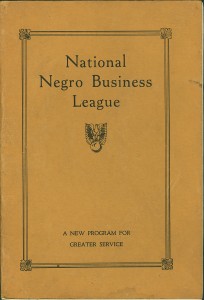 Booker T. Washington (1856-1915), founder and principal of Tuskegee Institute in Alabama, organized the National Negro Business League in 1900 to promote “commercial, agricultural, educational, and industrial advancement … and the commercial and financial development of the Negro.” Washington believed that blacks should “leave political and civil rights alone” in order to “make a businessman of the Negro.”
Washington was hoping that the League would encourage blacks to start their own businesses, thus proving that they were as capable as whites of economic success. This in turn, Washington reasoned, would eventually lead whites to allow blacks — or at least certain blacks — their right to vote and due process of law. The League’s membership included a number of successful black businessmen (and women) and professionals and a large number of the black middle class “strivers” who hoped to start their own businesses.
(more…)
Black History, Education
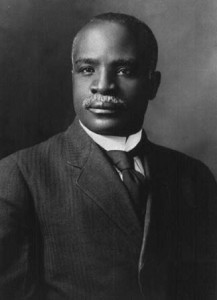
Kelly Miller
Kelly Miller was the sixth of ten children born to Kelly Miller, a free Negro who served in the Confederate Army during the Civil War, and Elizabeth (Roberts) Miller, a slave.
Miller received his early education in one of the local primary schools established during Reconstruction and, based on the recommendation of a missionary (Reverend Willard Richardson) who recognized Miller’s mathematical aptitude, Miller attended the Fairfield Institute in Winnsboro, South Carolina from 1878 to 1880.
Awarded a scholarship to Howard University, he completed the Preparatory Department’s three-year curriculum in Latin, Greek, and mathematics in two years (1880-1882), then attended the College Department at Howard from 1882 to 1886.
(more…)
Artists, Black History

“I create not with the intention to produce a finished piece of art, but to give nourishment to the artist within meâ€� – Phil Reid
(July 1, 1945 – June 9, 2009)
Philemon Timothy Reid was an African American Artist and recipient of a 2009 Lifetime Achievement Award from North Portland’s Interstate Firehouse Cultural Center.
Reid’s love for blues and jazz, particularly musicians John Coltrane, Miles Davis and singers Ella Fitzgerald and Nancy Wilson, was reflected in his colorful paintings and sculptures. Although Reid’s only formal art training was in high school, he developed his own unique style that was heavily influenced by Cubism and the artist Picasso.
“Philemon is part of an artistic movement that took hold in the 1970s that laid the foundation for Portland’s creative identity today,â€� according to Adrienne Flagg, creative director of North Portland’s Interstate Firehouse Cultural Center, where Reid’s art is prominently displayed. The IFCC’s dance studio exclusively showcases his early work. (more…)
Black History, Law, Politics
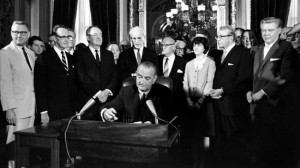
Voting Rights Act Signing
On August 6, 1965, President Lyndon B. Johnson signed the Voting Rights Act into law. Forty-seven years later, the U.S. is embroiled in a controversy over Voter ID laws that have been passed in several states, and which critics say could prevent millions of Americans from voting this year. Florida Rep. Frederica Wilson sent out a press statement today, making just that point. The statement read:
“Today, we commemorate the 47th anniversary of the Voting Rights Act, a historic milestone in the Civil Rights Movement. So many people died so that we could have the right to vote. I never thought that in my lifetime we would have to fight again for our Constitutional right to vote. (more…)
Black History, Business

On 1905-09-21, the Atlanta Life
Insurance Company was founded. They are the largest black-owned stockholder insurance company in America.
Founded by former slave, Alonzo Franklin Herndon, he purchased a small benevolent association for $140 and, with the acquisition and reorganization of two other companies in that year forming the Atlanta Mutual Insurance Association. In June 1996, Charles Cornelius began as the fifth president and chief executive officer and carries on the company’s proud legacy.
Today, Atlanta Life has assets of over $200 million and operates in 17 states.
Black History, Government
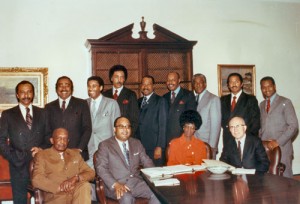
The 13 founding members of the CBC in the early 1970s. Standing L–R: Parren Mitchell (MD), Charles B. Rangel (NY), Bill Clay, Sr. (MO), Ron Dellums (CA), George Collins (IL), Louis Stokes (OH), Ralph Metcalfe (IL), John Conyers (MI), and Walter Fauntroy (DC). Seated L-R: Robert Nix, Sr. (PA), Charles Diggs (MI), Shirley Chisholm (NY), and Gus Hawkins (CA).
The Congressional Black Caucus is an organization representing the black members of the United States Congress. Membership is exclusive to African-Americans, and its chair in the 112th Congress is Representative Emanuel Cleaver of Missouri.
The caucus describes its goals as “positively influencing the course of events pertinent to African-Americans and others of similar experience and situation”, and “achieving greater equity for persons of African descent in the design and content of domestic and international programs and services.” (more…)

 Booker T. Washington (1856-1915), founder and principal of Tuskegee Institute in Alabama, organized the National Negro Business League in 1900 to promote “commercial, agricultural, educational, and industrial advancement … and the commercial and financial development of the Negro.” Washington believed that blacks should “leave political and civil rights alone” in order to “make a businessman of the Negro.”


