The Arts
Freedom’s People
(1941-42)
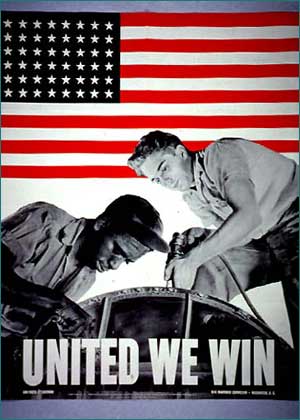
The first substantial program in mass media devoted exclusively to African-American life and history. Freedom’s People was a 9-part series on NBC exploring black history and achievements in areas like music, science, industry and sports. Created by Ambrose Caliver, a black official in the Office of Education, Freedom’s People earned critical acclaim. It features the contributions of leading black intellectuals, artists and activists.
The Arts
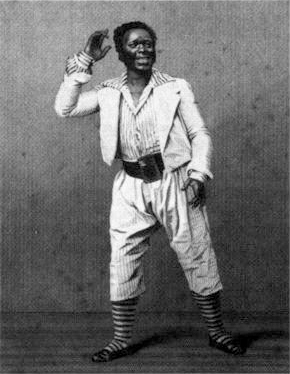
Ira Aldridge was born around 1805. His place of birth has been listed as Africa but more often Bel Air, Maryland. He was apprenticed as a carpenter under a German immigrant. Aldridge learned carpentry as well as German. Because of the lack of schools for African-Americans in Maryland, Aldridge moved to New York and attended the African Free School and Schenectady College. It was at Schenectady that Aldridge became interested in acting. He raised money and moved to Glasgow, Scotland.
He studied at the University of Glasgow, developing voice projection and dramatic skills. Aldridge was so gifted that by 1837 he was drawing crowds to see him portray Shakespearian roles. Aldridge was such a great actor that he performed for the president of the U.S., Queen Victoria and the Archduch of Chambory. He received many awards and was heavily decorated. Aldridge was even the first African-American to become a knight. He married twice and was divorced once. Aldridge died in Poland in 1867. At the Shakespearean Memorial Theatre in Stratford-On-Avon, England, a chair is dedicated to the memory of Ira Aldridge.

Government
Despite its creation in 1791, the District of Columbia did not have its own local government or mayor until 1974. The people of Washington elected Walter E. Washington, an attorney and expert on urban housing, as their first mayor. He was born in the District in 1915, attended Howard University and Howard Law School and served on the National Capital Housing authority. Ironically, the citizens of the capital of the free world had to fight for their own self-determination. When they succeeded, they chose Walter E. Washington to be their leader. He was re-elected in 1976.

Media
Alice Allison Dunnigan (April 27, 1906 – May 6, 1983) was an American journalist, civil rights activist and author. Dunnigan was the first African American female correspondent to receive White House credentials, and the first black female member of the Senate and House of Representatives press galleries. She wrote an autobiography entitled Alice A. Dunnigan: A Black Woman’s Experience. She is commemorated by an official Kentucky Historical Society marker.
Alice chronicled the decline of Jim Crow during the 1940s and 1950s, which influenced her to become a civil rights activist. She was inducted into the Kentucky Hall of Fame in 1982.
During her time as a reporter, she became the first black journalist to accompany a president while traveling, covering Harry S. Truman’s 1948 campaign trip.
In 2022, the White House Correspondents’ Association created the Dunnigan-Payne Lifetime Achievement Award in memory of Dunnigan and fellow White House reporter Ethel Payne.
Read more of this article on Wikipedia.
Abolition
A twenty eight year-old man who “was tall, and well-made, and possessed of a considerable share of intelligence.” After being whipped severely by his master and hearing of being auctioned off in the near future, Ford decided to enlist the help of the committee running the Underground Rail Road in order to escape his dismal fate. Still recounts Ford’s flight to freedom:
The first day of the woods he passed in prayer incessantly, all alone. In this particular place of seclusion he reamined “four days and nights,” “two days suffered severely from hunger, cold and thrist.” However, one who was a “friend” to him, and knew his whereabouts, managed to to get some food to him and consoling words; but at the end of the four days this friend got inot some difficulty and thus Sheridan was left to “wade through deep waters and head winds” in an almost hopeless state. There he could not consent to stay and starve to death. Accordingly, he left and found another place od seclusion-with a friend in the town- for a pecuniary consideration. A secret passage was procured for him on one of the steamers running between Philadelphia and Richmond, Va. When he left his poor wife, Julia, she was then “lying in prison to be sold,” on the simple charge of having been suspected of conniving at her husband’s escape. As a woman she had known something of the “barbarism of slavery,” from every-day experience, which the large scars about her head indicated-according to Sheridan’s testimony. She was the mother of two children, but had never been allowed to have the care of either of them. The husband, utterly powerless to offer the least sympathy in word or deed, left his dark habitation of cruelty, as above referred to, with no hope of ever seeing wife or child again in this world.

The Arts
Stowe’s landmark novel, Uncle Tom’s Cabin, has often been cited as one of the causes of the Civil War. She became outraged by written accounts of the injustice and cruelty of the slave system and traveled to the South to investigate it herself. The material she gathered became the source for Uncle Tom’s Cabin; or Life Among the Lowly. The book, which was first published in 1831 in serial form in an abolitionist newspaper, became an immediate sensation, soon gaining worldwide popularity. Stowe was also an ardent supporter of women’s rights, and she collaborated with her sister, Catherine Beecher, on nineteen domestic-science books.
