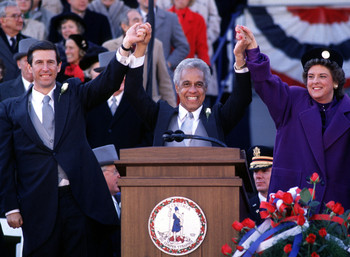
Black History, Other, Politics
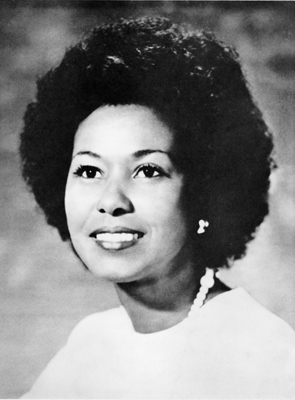
Image courtesy of National Archives and Records Administration
Representative, 1973-1979, Democrat from California
Yvonne Brathwaite Burke was a rising star in California and national politics years before she won a seat in the U.S. House. In 1966, she became the first African-American woman elected to the California assembly. At the 1972 Democratic National Convention she served as vice chair of the platform committee, gaining national television exposure. That same year she became the first black woman from California (and one of only three black women ever) elected to the House.
Her meteoric career continued with a prime appointment to the Appropriations Committee and her election as the first woman chair of the Congressional Black Caucus (CBC). But Burke’s most notable distinction in the eyes of much of the public occurred in 1973, when she became the first Congresswoman to give birth and be granted maternity leave while serving in Congress. (more…)
Black History, Politics

Patricia Roberts Harris
Patricia Roberts Harris (1924-85), former cabinet official and the only woman to have headed three federal departments, joined the faculty of The George Washington University Law School in the fall of 1983. Harris graduated from the GW National Law Center at the head of her class in 1960, receiving her JD with honors.
“She is truly one of the most distinguished graduates of the school and one of the most distinguished women in public life,” said National Law Center Dean Jerome A. Barron in announcing the appointment. “She brings great understanding of government, as well as experience in it, to the teaching of public law. (more…)
Black History, Politics

Bakke Decision Protesters
Bakke decision, formally Regents of the University of California v. Bakke, ruling in which, on June 28, 1978, the U.S. Supreme Court declared affirmative action constitutional but invalidated the use of racial quotas. The medical school at the University of California, Davis, as part of the university’s affirmative action program, had reserved 16 percent of its admission places for minority applicants.
Allan Bakke, a white California man who had twice unsuccessfully applied for admission to the medical school, filed suit against the university. Citing evidence that his grades and test scores surpassed those of many minority students who had been accepted for admission, Bakke charged that he had suffered unfair “reverse discriminationâ€� on the basis of race, which he argued was contrary to the Civil Rights Act of 1964 and the equal protection clause of the U.S. Constitution’s Fourteenth Amendment. (more…)

Black History, Events, Politics

The Rainbow PUSH Coalition is the result of a merger between Operation PUSH and the Rainbow Coalition. Established in 1971 by Rev. Jackson, People United to Save Humanity (later changed from “Save” to “Serve”)–PUSH, was an organization dedicated to improving the economic conditions of black communities across the United States. In the 1970’s, PUSH expanded into areas of social and political development using direct action campaigns, a weekly radio broadcast, and awards that honored prominent blacks in the U.S. and abroad. Through Operation PUSH, Rev. Jackson established a platform from which to protect black homeowners, workers and businesses. (more…)
Black History, Politics
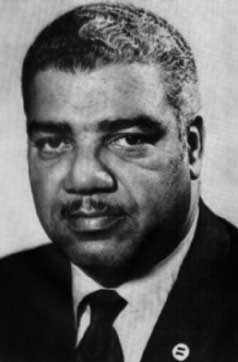
Whitney Moore Young
A civil rights leader who urged African Americans to work within the system, Whitney Moore Young, as executive director of the National Urban League from 1961 to 1971, played a leading role in persuading America’s corporate elite to provide better opportunities for African Americans.
Young worked with President Lyndon Johnson on civil rights and anti-poverty programs during the 1960s, while calling for a “domestic Marshall Plan” (similar to U.S. aid to revive Europe after World War II).
He was one of the leaders of the 1963 March on Washington and in 1964 he organized the Community Action Assembly to fight poverty in African-American communities. He was awarded the Medal of Freedom, the nation’s highest civilian honor, in 1969.
Two years later at the age of 49, Young drowned in Lagos, Nigeria while participating in an annual African-American dialogue on relations between the two continents.
Black History, Firsts, Politics
L. Douglas Wilder
L. Douglas Wilder was (the first Black) governor of Virginia from 1990 until 1994. His was a political career of many firsts: the grandson of slaves, he was the first African American elected governor of any state in America.
He was the first black member of the Virginia Senate in the twentieth century. And he was the first African American to win statewide office in Virginia when he was elected lieutenant governor in 1985. A Democrat, he ran briefly for United States president in 1991 and in 2004 was elected mayor of Richmond, serving until 2008. (more…)